

From heaven to human Hearts: The story of Hajr-e-Aswad and tears of pilgrims
Roy Zia Ur Rahman
ISLAMABAD, May 31 (APP): In the heart of the Grand Mosque, surrounded by millions of believers dressed in white, stands a small black stone that carries centuries of history, emotions, prayers and longing.
For Muslims around the world, known as Hajr-e-Aswad is not merely a stone fixed into the corner of the Holy Kaaba. It is a heavenly gift, a sacred symbol connected to Prophets Ibrahim and Ismail (AS), and a place touched by the blessed hands and lips of Prophet Muhammad (Peace Be Upon Him).
During Hajj 1447 AH, emotions surrounding the Black Stone became even more intense as millions of pilgrims arrived from every corner of the world carrying prayers, regrets, hopes, and dreams in their hearts.
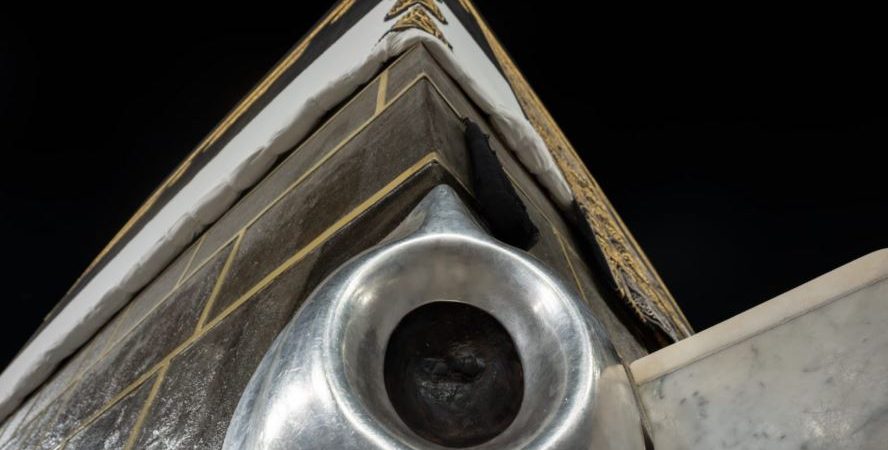
On the second day of Eid Al-Azha, the Saudi Press Agency (SPA) shared rare and exclusive close-up photographs of Hajr-e-Aswad captured after Fajr prayers at the Grand Mosque, revealing astonishing details of the sacred stone that many pilgrims spend hours simply trying to see from a distance.
People arrive at the Haram carrying the burdens of sins, worries, and broken hearts. But when their eyes suddenly fall upon the Holy Kaaba, many are left speechless. Tears begin flowing before words do.
The Kaaba, towards which Muslims turn five times a day in prayer from every part of the world, stands before them in reality.
Allah Almighty is present everywhere, yet this sacred place holds unmatched spiritual significance because it is the House of Allah built by Prophet Ibrahim and Prophet Ismail (AS), and because Prophet Muhammad (Peace Be Upon Him) performed Tawaf around it.
Embedded within one corner of this sacred structure is the Black Stone, believed in Islamic tradition to have descended from Paradise.
According to historical narrations, Angel Jibreel (Gabriel) brought the stone from heaven. It was initially white, brighter than milk, but according to the sayings of Prophet Muhammad (Peace Be Upon Him), the sins of humanity darkened its color over time.
Today, only a few visible fragments of the original stone remain, fixed together inside a silver frame. Other parts are preserved beneath a mixture of musk, wax, and amber, carefully maintained by Saudi authorities.
Despite modern crowd-control systems and organized movement inside the Mataf, reaching the Black Stone remains one of the most emotional moments for pilgrims.
A Pakistani pilgrim, Hajran, talking to APP near Mataf, said she waited the entire day and most of the night for crowds to reduce so she could reach close enough to kiss the stone.
It was extremely difficult and exhausting because of the crowd, but when I finally kissed Hajr-e-Aswad, it felt as if light entered my heart, she said with tears in her eyes.
Another Pakistani pilgrim, Rai Imran from Jhang district, described a deeply emotional connection with the sacred stone.
During every Tawaf, I keep looking towards Hajr-e-Aswad to count my rounds, he told APP. When I place my lips where Prophet Muhammad (Peace Be Upon Him) once placed his blessed lips, a strange peace, purity, and spiritual light enter the heart.
For many pilgrims, simply pointing towards the Black Stone during Tawaf becomes an unforgettable spiritual memory.
Asma Bibi, another pilgrim from Pakistan, said visiting the Kaaba, kissing Hajr-e-Aswad and seeing the Roza-e-Rasool (Peace Be Upon Him) in Madinah had been the dream of her entire life.
I came carrying this dream for decades, she said emotionally. Today Allah accepted it.
Islamic scholars explain that Muslims do not worship the Black Stone. Rather, they follow the Sunnah of Prophet Muhammad (Peace Be Upon Him), who kissed it during Tawaf.
Hazrat Umar Farooq (May Allah Be Pleased With Him) once addressed the stone saying: I know you are only a stone that neither harms nor benefits. Had I not seen the Prophet (Peace Be Upon Him) kissing you, I would not have kissed you.
Through centuries, Hajr-e-Aswad has witnessed extraordinary historical events. It survived attacks, theft attempts and even the infamous Qarmatian assault nearly 1,100 years ago when the stone was removed from the Kaaba for more than twenty years before finally being returned.
Today, Saudi Arabia uses advanced technology, artificial intelligence and ultra-high-resolution imaging systems to preserve and document the sacred stone. Authorities once captured more than 1,000 specialized images of Hajr-e-Aswad using Focus Stacking technology with nearly 49,000 megapixels, revealing details invisible to the human eye.
Yet despite all technology and historical study, the real connection between pilgrims and Hajr-e-Aswad remains deeply emotional rather than scientific.
At every hour of the day and night, waves of believers continue circling the Holy Kaaba under glowing lights, whispering prayers, raising hands and searching for moments of acceptance.
Some only point towards the Black Stone from afar. Some struggle for hours to reach it. Some cry after touching it. Some simply stare at it silently.
But almost every pilgrim leaves with the feeling that they carried something heavy into the Haram and left something lighter behind.
Related News

High Commission of Malaysia organises Malaysia–Pakistan business engagement 2026 in Islamabad
ISLAMABAD. /DNA/ – On 15 October 2026, the High Commission of Malaysia in Islamabad organisedRead More

Political party chief upset over not getting KP governorship, role in setup: Naqvi
LAHORE: Interior Minister Mohsin Naqvi on Friday claimed that the head of a political partyRead More
Comments are Closed