

Emerging Technologies and the Future Warfare: Adapt or Perish
By Sanobar Nadir
For centuries, wars have been won by the brilliance of men, their numbers, their battlefield skills, and their courage. But all of that is changing, and changing fast. The technological advancement the world is witnessing today has pulled warfare away from its traditional sphere and pushed it toward something far more unconventional.
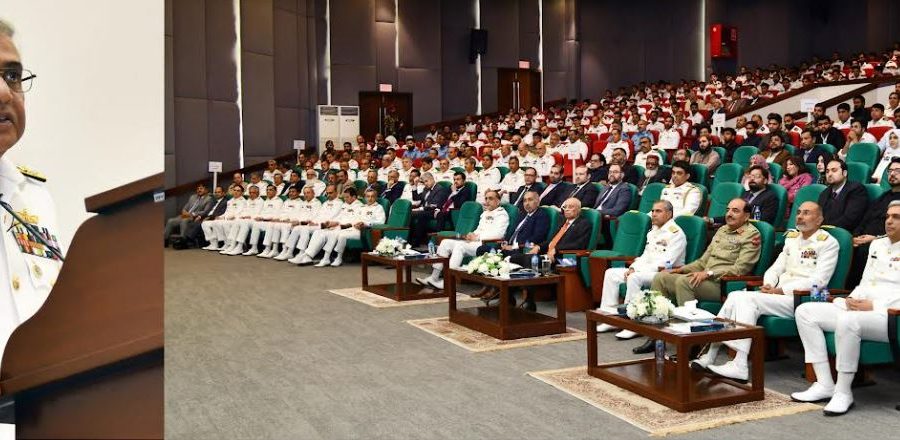
That conversation arrived in Karachi last week, as the Maritime Centre of Excellence hosted a two-day international conference on “Emerging Technologies and the Future Warfare,” bringing together naval officers, academics, and industry officials to highlight the significance of emerging technologies in contemporary warfare.
Chief of the Naval Staff Admiral Naveed Ashraf pointed to the Indian Ocean as a region where the future of warfare is already being shaped, a waterway so critical to global trade that any disruption would have consequences far beyond the region’s borders. But his remarks went beyond geography. He highlighted the need for the implementation of the Triple Helix model of innovation, a framework that ties together academia, industry, and the military into a single engine of technological development. He spoke of the need to integrate both manned and unmanned technologies into the military, and to embed emerging technologies into the framework of how Pakistan’s armed forces train, plan, and fight. The message was clear: collaboration is not a suggestion. It is the foundation on which a modern defence ecosystem must be built.
Speakers examined the growing intersection between emerging technologies and modern warfare, exploring how innovations are reshaping naval operations, transforming force structures, and redefining what it means to hold strategic advantage at sea. The discussions ranged from the employment of advanced technologies in naval warfare to the dual-use nature of emerging tools. The impact of these technologies on maritime strategy and policy within the Indian Ocean Region was a thread that ran through nearly every session.
It is a shift that defence analysts have been warning about for years. In his book The Last War, Pravin Sawhney argues that conventional military strength will count for little in the conflicts ahead. What will determine the outcome, he writes, is who controls the artificial intelligence, the unmanned systems, and the cyberspace.
One framework that surfaced repeatedly during the conference was the OODA loop, a decision-making model that stands for Observe, Orient, Decide, and Act. In conventional warfare, the side that moves through this cycle faster gains the upper hand. In AI-driven warfare, that cycle compresses to milliseconds, and the advantage shifts decisively to whoever has built the faster, smarter system.
Speakers also analyzed contemporary models of technological development for military application, with a particular focus on how defence innovation actually gets built. The academia-industry-military nexus, often described through the Triple Helix model, emerged as a defining prescription. Turkiye was held up as a case study, a country that has deliberately and successfully woven together its universities, defence industry, and armed forces to produce indigenous military technology at scale. The conference discussed how Pakistan can adopt a similar approach and implement this model.
One speaker discussed what he called the three Ms, machine, mind, and mass. The machine is the technology. The mass is the numbers. But it is the mind, human judgement, strategic thinking, and adaptability, that binds the two together. The argument was not that technology is irrelevant, but that technology without the right human architecture behind it is simply expensive hardware. As the old saying goes, the power is not in the gun but in the hand that holds it.
The conference concluded with a reaffirmation that sustained collaboration between military, industry, and academia is no longer optional. It is the only credible path forward. The gap between legacy thinking and present reality in defence is widening, and the countries that refuse to acknowledge it are already falling behind. Adapt or perish, as one speaker put it, is no longer a rallying cry. It is a strategic reality.
Yet the conference was careful not to reduce warfare entirely to technology. Speakers were consistent on one point: machines can process, calculate, and execute at speeds no human can match, but they cannot replace the human judgement, human understanding of context, or their accountability for the decisions made on the battlefield. The debate is not man versus machine. It is about how the two work together and form a formidable and powerful defence system.
Author’s Contact Info
Email: [email protected]
Related News

Better Rules, Missing Teeth
A fair reading of the Public Procurement Rules, 2026 By Ali khan adv – ProcurementRead More

A nation’s conscience buried under the rubble
Pakistan does not suffer from a shortage of talent or resources. What it lacks isRead More
Comments are Closed