

PIDE Warns: Gulf instability becomes Pakistan’s inflation
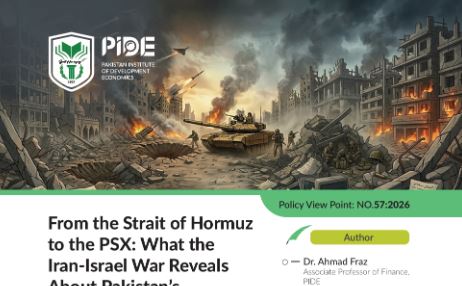
ISLAMABAD, APR 18 /DNA/ – The Pakistan Institute of Development Economics (PIDE) has issued a new Policy Viewpoint by Dr. Ahmad Fraz, Associate Professor of Finance, titled “From the Strait of Hormuz to the PSX: What the Iran-Israel War Reveals About Pakistan’s Economic Vulnerability.” The study highlights that the Iran–Israel conflict is not a distant geopolitical development for Pakistan.
It is already being reflected in the country’s economy through oil markets, inflation expectations, and movements in the Pakistan Stock Exchange. The viewpoint argues that Pakistan’s exposure extends beyond rising oil prices and is rooted in structural vulnerabilities. As an oil-importing economy closely linked to Gulf energy routes, Pakistan remains highly sensitive to disruptions in the Strait of Hormuz, where even limited instability can quickly translate into higher costs, external pressures, and financial uncertainty.
The study draws on recent market developments to substantiate its argument. The Pakistan Stock Exchange did not experience a uniform decline, nor did it remain stable. Instead, it underwent correction, heightened volatility, and an uneven recovery. This pattern suggests that investors interpreted the conflict not as a temporary disturbance, but as a broader macro-financial shock with implications for inflation, business costs, investor confidence, and overall economic stability. Sectoral responses were also differentiated: while oil and gas-related segments demonstrated some resilience, the banking sector remained under sustained pressure, reflecting underlying domestic vulnerabilities.
According to the viewpoint, the stock market functioned as an early indicator of emerging economic stress. Financial markets adjusted rapidly as they incorporate expectations about future risks rather than current conditions. As concerns related to oil supply, inflation, exchange-rate pressures, and financing conditions intensified, market valuations responded ahead of their reflection in official economic indicators. The transmission of the shock occurred through multiple interconnected channels, including supply disruptions, increased freight and insurance costs, imported inflation, rising operational expenses, and a broader repricing of financial risk.
A key finding of the study is the divergence across sectors. Banking stocks emerged as a clear indicator of domestic stress, reflecting concerns related to inflation, credit quality, and tightening financial conditions. While the oil and gas sector exhibited relative resilience, it did not provide complete insulation, as broader country risk and structural constraints continued to influence performance.
The analysis further emphasizes that the risks extend beyond market volatility. Drawing on PIDE research by Satti and Naeem (2026), the study indicates that even a modest disruption in Gulf energy flows can significantly increase Pakistan’s import burden, reverse improvements in the external account, and intensify inflationary pressures. The current episode is therefore best understood not as a temporary disturbance, but as a real-time stress test of Pakistan’s economic structure.
Importantly, the viewpoint also outlines a set of policy measures aimed at reducing future vulnerability. These include the introduction of event-triggered risk disclosure requirements for listed companies, the establishment of a coordinated Gulf Shock Dashboard to enhance market communication, and the strengthening of energy contingency planning. Over the longer term, the study underscores the need to reduce dependence on imported energy and to build a more resilient economic framework capable of absorbing external shocks more effectively.
The central message of the Policy Viewpoint is that Pakistan’s vulnerability lies not only in oil price movements, but in the speed with which uncertainty in the Gulf is transmitted into inflation, financial markets, and the external sector. Sustainable stability will depend less on external conditions and more on strengthening domestic resilience through timely and coordinated policy action.
Related News

Pakistan highlights GSP+ importance in EU meeting
NEW YORK, SEPT 21 /DNA/ – Deputy Prime Minister and Foreign Minister Senator Mohammad IshaqRead More
Iran praises Pakistani leadership’s mediation efforts amid Middle East crisis
TEHRAN: Interior Minister Mohsin Naqvi’s met Iranian counterpart Eskandar Momeni as the duo exchanged viewsRead More
Comments are Closed