

Premature deindustrialization hurting youth employment, warns PIDE Seminar
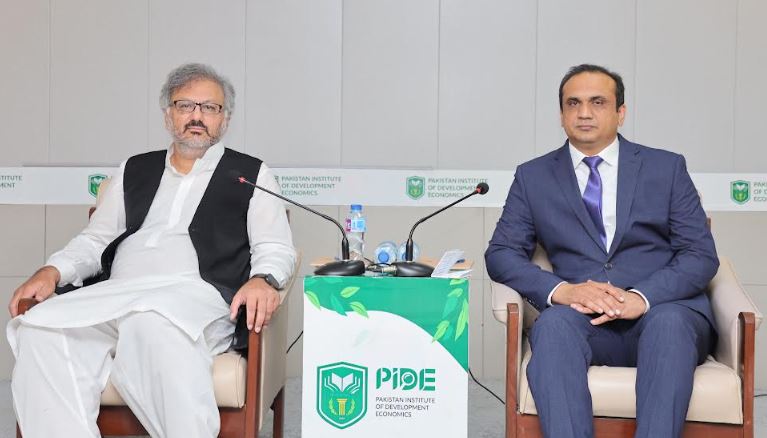
ISLAMABAD, MAY 6: /DNA/ – The Pakistan Institute of Development Economics (PIDE) organized a seminar on “Industrial Competitiveness in Pakistan” today in Islamabad, featuring Usman Khan, Deputy Team Lead – REMIT and Director of the Technology for People Initiative (TPI) at LUMS, as the keynote speaker. The session was moderated by Dr. Amjad Masood, Chief of Research and Director of CEI, PIDE, and was also attended virtually by participants from across the country.
Dr. Masood opened the seminar by emphasizing that sustainable economic growth depends on a competitive industrial sector capable of producing goods that meet global standards in both quality and price, while remaining integrated into international supply chains. He underscored the critical role of innovation, technology, and industrial transformation in shaping Pakistan’s economic future.
In his address, Usman Khan highlighted that despite the global focus on digitalization and services, manufacturing remains a central driver of economic growth, employment generation, and export competitiveness. He observed that Pakistan, once ahead of countries such as Vietnam, Bangladesh, India, and South Korea in GDP per capita and exports, has gradually lost its economic edge. Over the past several decades, the industrial sector has stagnated, and labor has shifted directly from agriculture to low-productivity informal services instead of transitioning through manufacturing, a phenomenon he described as premature deindustrialization, adversely affecting youth employment, export diversification, and long-term productivity.
Mr. Khan noted that Pakistan’s export basket remains narrow and heavily dependent on low-value-added products, particularly textiles and primary commodities, with limited diversification into advanced sectors like electronics and machinery. He stressed that modern exports are increasingly driven by capabilities and innovation rather than products alone, making human capital development and technical skills critical for competitiveness.
The seminar examined structural and policy constraints hindering industrial growth, including high energy costs, policy inconsistency, limited access to credit, burdensome taxation and regulation, low investment in research and development, and weak institutional support. Mr. Khan emphasized that effective industrial policy should go beyond short-term subsidies to focus on productivity enhancement, technological upgrading, worker training, strategic sector support, and active engagement in global value chains.
He also highlighted lessons from global experience, emphasizing the strategic use of tariffs, foreign direct investment, state-owned enterprises, and public-private dialogue to create globally competitive firms, foster innovation, and drive export growth. Mr. Khan noted emerging opportunities in sectors such as electric vehicles, where Pakistan can leverage existing capabilities to participate in global production networks without overextending into fully finished product manufacturing.
The seminar concluded with an engaging discussion on the future of industrial policy, youth employment, technology adoption, and Pakistan’s path toward a more competitive, diversified, and resilient economy. PIDE reaffirmed its commitment to fostering research, dialogue, and evidence-based policy recommendations to strengthen Pakistan’s industrial base and ensure sustainable economic growth.
Related News
Gilani calls for stronger Pakistan-Germany ties through trade, investment
ISLAMABAD, Oct 16 (DNA):Chairman of the Senate, Syed Yousuf Raza Gilani, has called forRead More
WWF has 12 employees on deputation, 90 posts vacant: NA told
ISLAMABAD, Oct 16 (DNA):Minister of State for Overseas Pakistanis & Human Resource Development MuhammadRead More
Comments are Closed