

Victoria Schofield urges inclusive Kashmir dialogue for peace
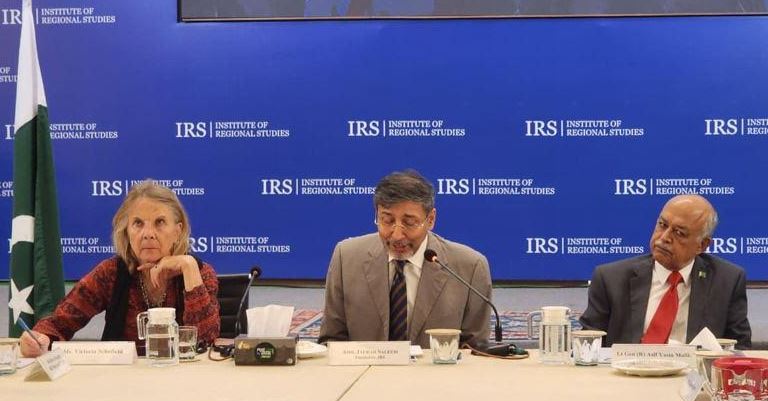
ISLAMABAD, MAY 15 /DNA/ – Victoria Schofield, a renowned British historian was speaking at a high-level policy discussion titled “Jammu and Kashmir Dispute: Navigating Pathways to Peace” organized by Institute of Regional Studies, in collaboration with Youth Forum for Kashmir. Addressing the constitutional developments of 5 August 2019, Ms. Schofield observed that the revocation of Jammu and Kashmir’s special status, combined with heavy militarization and communication restrictions, had intensified alienation in the Kashmir Valley and reinforced demands for self-determination. She stressed for an inclusive political process involving the genuine representation of the people of Jammu and Kashmir.
While referring to prospects of peace in the region she remarked that “the future is not in the rigidity of nation states, but the fluidity of cross-cultural and regional communication. To achieve peace in Jammu and Kashmir, dialogue must replace hostility”. She stressed that any durable resolution of the dispute must be grounded in on-ground realities rather than rigid cartographic claims. She highlighted the strategic implications of the China dimension, particularly regarding Aksai Chin and the legacy of the 1962 Sino-Indian conflict, emphasizing that excluding China from analytical and diplomatic considerations would weaken any meaningful settlement framework.
Tracing the historical evolution of the dispute from the 1948–49 war to the post-Simla Agreement Line of Control, Ms. Schofield noted that while territorial realities have remained largely static, the strategic environment has transformed significantly due to nuclearization, technological developments, and geopolitical competition. She warned that rapid military mobilization, misinformation, and escalatory rhetoric in a nuclearized environment increase the risk of miscalculation and wider regional confrontation.
Ambassador Jauhar Saleem, President Institute of Regional Studies, while acknowledging fragility of ‘ceasefire’ between India and Pakistan, reaffirmed Pakistan unwavering commitment to the Kashmir cause, grounded in the principles of justice, human rights, and the right to self-determination,
The discussion also featured remarks from Senator Zarqa Suharwardy Taimur, who emphasized that Pakistan and India, bound by geography and history, cannot remain perpetual adversaries. She called for peaceful coexistence, warning that another war between two nuclear-armed states would have catastrophic consequences for South Asia.
Lt Gen Asif Yasin Malik described Kashmir as the central issue driving tensions between Pakistan and India, arguing that sustainable peace is impossible without addressing the core dispute. Prominent Kashmiri voices at the event emphasized the importance of self-determination, narrative-building, and inclusive peace processes. Participants also highlighted the growing importance of information warfare, strategic communication, and media narratives in shaping international perceptions of Kashmir. Several speakers called for stronger intellectual and diplomatic engagement to counter misinformation and ensure that the lived experiences of Kashmiris are not marginalized.
Related News

Petrol price increases by Rs3.40, HSD by Rs6.72 per litre
ISLAMABAD: The government on Wednesday raised the prices of petrol and high-speed diesel (HSD) byRead More
IMF Austerity Cuts Quadrupled Over Past Decade
IMF-required austerity cuts quadrupled over past decade, and new Fund policy is poised to pushRead More
Comments are Closed