

Russian wants a political solution of Ukraine issue
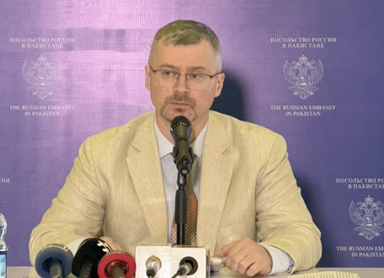
Ambassador Khorev argued that the crisis extends beyond a bilateral dispute between Russia and Ukraine, portraying it instead as a wider confrontation between Russia and Western powers
Ansar Mahmood Bhatti
ISLAMABAD: Ambassador Albert P. Khorev addressed a gathering on the evolving situation in and around Ukraine, presenting Russia’s perspective on the military, political, economic, and legal aspects of the ongoing conflict. The briefing began on a solemn note as participants observed a minute of silence in memory of the victims of the Siege of Leningrad, marking the 85th anniversary of one of the most tragic episodes of World War II.
The Ambassador opened his remarks by discussing Russia’s recent parliamentary elections, describing them as a significant democratic exercise that witnessed a record voter turnout. According to him, the elections were conducted successfully despite what he characterized as external pressure and attempts to disrupt the process through drone attacks on Russian cities. He emphasized that the high level of public participation demonstrated confidence in Russia’s political system and institutions.
A major portion of the briefing focused on the broader geopolitical dimensions of the Ukraine conflict. Ambassador Khorev argued that the crisis extends beyond a bilateral dispute between Russia and Ukraine, portraying it instead as a wider confrontation between Russia and Western powers. In his view, Ukraine has become the focal point of a geopolitical struggle in which Moscow faces sustained political, economic, and military pressure from the collective West.
Addressing economic issues, the Ambassador maintained that Western sanctions have not succeeded in achieving their main objective of weakening the Russian economy. He contended that instead of causing economic collapse, the restrictions have accelerated economic adjustments within Russia while imposing substantial costs on countries that introduced the sanctions. He highlighted the growing importance of alternative financial systems and settlements in national currencies, particularly within regional and international organizations such as BRICS, the Shanghai Cooperation Organization (SCO), and ASEAN. According to his assessment, these developments are contributing to the gradual emergence of a more diversified global economic order.
Maritime security and international navigation were also key topics of discussion. Ambassador Khorev criticized actions taken against vessels allegedly associated with Russia, describing such measures as politically motivated and contrary to international norms. He also expressed concern over increasing attacks on civilian shipping in the Black Sea and the Sea of Azov, warning that any escalation could threaten regional stability and disrupt international trade routes.
Food security was presented as another important area affected by the conflict. Comparing the positions of Russia and Ukraine in global wheat exports, the Ambassador stressed Russia’s significant contribution to international grain supplies. He argued that restrictions affecting Russian agricultural exports could have negative consequences for global food markets and may place additional pressure on countries heavily dependent on imported food commodities.
The briefing also examined legal dimensions of the conflict. Ambassador Khorev reiterated Russia’s opposition to international mechanisms established by Western countries to pursue compensation claims related to the war. He stated that Moscow does not recognize such frameworks and therefore does not consider itself bound by their decisions. At the same time, he highlighted a ruling issued by the Permanent Court of Arbitration in The Hague, which he described as an important development in the legal dispute between Russia and Ukraine.
In addition, the Ambassador touched upon humanitarian and religious concerns. He referred to issues involving Ukrainian children affected by the conflict and expressed concern regarding the situation of the Ukrainian Orthodox Church. According to his remarks, religious institutions and believers linked to the Church continue to face significant challenges amid the ongoing political tensions.
Concluding his presentation, Ambassador Khorev reaffirmed Russia’s commitment to a political and diplomatic resolution of the conflict. He stated that negotiations remain the preferred path toward a lasting settlement and emphasized that any future dialogue must take Russia’s national interests into consideration. He also rejected suggestions that Russia is preparing military action against European or NATO member states, asserting that Moscow has neither plans nor reasons to pursue such a course.
Following the briefing, guests viewed an exhibition titled “Crimean Gold: Civilized Europe Plunders Russian Treasures,” showcasing archaeological artifacts from Crimea. The exhibition highlighted Russia’s position regarding the ownership and future return of these historical treasures, adding a cultural dimension to a discussion otherwise dominated by contemporary geopolitical issues.
Related News
PM Shehbaz, Azerbaijan President Aliyev Discuss Expanding Economic Cooperation in Telephone Call
ISLAMABAD: Prime Minister Muhammad Shehbaz Sharif and President Ilham Aliyev of Azerbaijan held a telephoneRead More
Russian wants a political solution of Ukraine issue
Ambassador Khorev argued that the crisis extends beyond a bilateral dispute between Russia and Ukraine,Read More
Comments are Closed