

PIDE warns temporary window not structural transformation yet
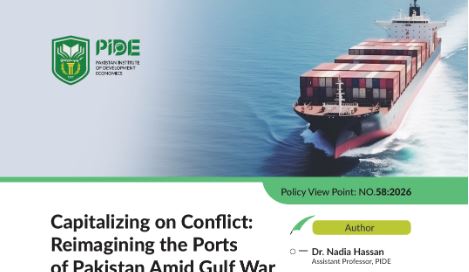
ISLAMABAD, APR 21 /DNA/ – The Pakistan Institute of Development Economics (PIDE) has released a new policy brief highlighting a rare and time-sensitive opportunity for Pakistan to reposition its ports as competitive regional and global trade hubs amid ongoing disruptions in Gulf shipping routes. Authored by Dr. Nadia Hassan, Assistant Professor at PIDE, the brief titled Capitalizing on Conflict: Reimagining the Ports of Pakistan Amid Gulf War argues that while Pakistan is already benefiting from diverted cargo flows, the real challenge lies in converting these temporary gains into sustained economic advantage through urgent and coordinated reforms.
With nearly one-fifth of global trade passing through the Strait of Hormuz, recent tensions and its closure in March 2026 triggered a major rerouting of international shipping away from traditional hubs such as Dubai’s Jebel Ali and Oman’s Salalah. Pakistan’s ports—Karachi Port, Port Qasim, and Gwadar—located outside the direct conflict zone yet in close proximity to key shipping lanes, have emerged as viable alternatives, placing the country at the center of a rapidly shifting maritime landscape.
The scale of this shift has been significant. Karachi Port alone handled approximately 11,000 transshipment containers and recorded 133 vessel calls in March, surpassing its total transshipment activity for the previous year. Port Qasim absorbed nearly 25 percent of redirected cargo and processed over 4,000 TEUs in a single day, registering an extraordinary 2,302 percent increase in transshipment activity. Gwadar Port, though still developing, marked its entry into the regional transshipment network by berthing its first vessel, signaling strong long-term potential as a deep-sea hub at the mouth of the Persian Gulf.
Despite these encouraging trends, PIDE cautions that the current gains reflect a temporary window rather than a structural transformation. Karachi’s urban congestion and limited expansion capacity, Port Qasim’s upstream constraints, and Gwadar’s underdeveloped ecosystem all pose serious challenges to sustaining this momentum. Without timely policy action, Pakistan risks losing this opportunity as quickly as it emerged.
A comparative analysis with leading regional ports underscores the gap. Jebel Ali handles approximately 15.5 million TEUs annually compared to Karachi’s 2.65 million, while its Port Liner Shipping Connectivity Index stands at 775 against Karachi’s 310 and Port Qasim’s 131. Vessel turnaround times at Salalah range between 10 to 20 hours, whereas Pakistan’s ports report inconsistent performance. Similarly, Pakistan’s ports operate with only 5 to 6 ship-to-shore cranes compared to 27 to 29 in leading hubs, and berth occupancy ratios remain below the global optimal range of 50 to 70 percent.
The brief emphasizes that these shortcomings are not merely infrastructural but also institutional and operational. Successful ports like Jebel Ali integrate logistics, industrial zones, and free trade ecosystems to enhance efficiency and reduce costs, while Pakistan’s ports function largely as isolated nodes with weak hinterland connectivity and limited digitalization. Although Pakistan enjoys a cost advantage in labor, this is offset by high port charges, procedural delays, and a semi-skilled workforce.
To address these challenges, PIDE proposes a focused reform agenda including infrastructure modernization, operational automation, expansion of container handling capacity, and integration of ports with export processing and logistics zones. The brief also calls for strategic partnerships with global shipping lines, rationalization of procedural costs, and investment in workforce development to meet modern maritime standards. These measures are essential to transform conflict-driven cargo diversion into sustained trade growth and long-term economic resilience.
PIDE concludes that Pakistan’s geographic advantage alone is insufficient to secure a lasting position in global trade. The current geopolitical disruption presents a defining test of policy readiness and institutional capacity. With decisive action, Pakistan can transform its ports from underutilized assets into dynamic engines of commerce and connectivity. Without it, a historic opportunity may be lost.
Related News
JUI Chief, Prime Minister discuss prevailing political situation
ISLAMABAD, Oct 10 (DNA): President of Jamiat Ulema-e-Islam (JUI), Maulana Fazl Ur Rehman, on SaturdayRead More

Finance Minister departs for World Bank Group–IMF Annual meetings 2026 in Bangkok
ISLAMABAD, OCT 10 /DNA/ – Federal Minister for Finance and Revenue, Senator Muhammad Aurangzeb, isRead More
Comments are Closed