

HEC, British Council discuss measures to strengthen transnational education in Pakistan
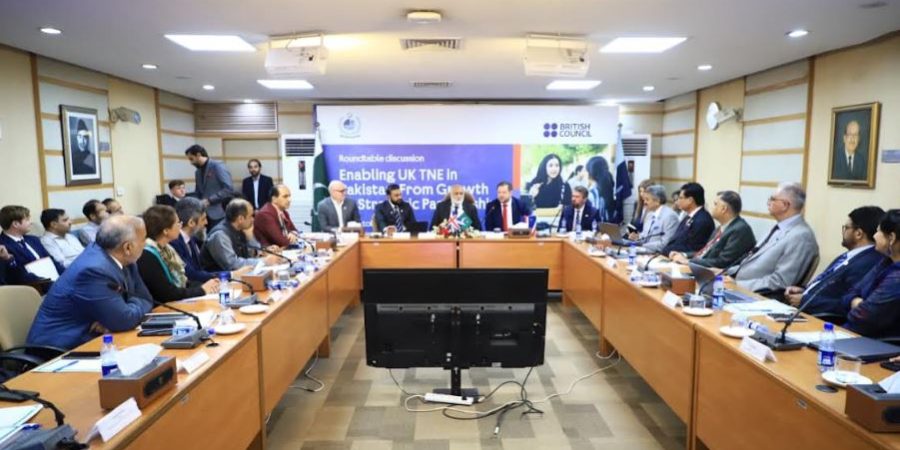
UK Committed to Cementing Academic, Research Linkages with Pakistan: Minister Stephen Doughty
ISLAMABAD, OCT 7 /DNA/ – The Higher Education Commission (HEC) Pakistan and the British Council Pakistan held a roundtable discussion titled “Enabling UK TNE in Pakistan: From Growth to Strategic Partnership” to deliberate on measures for strengthening Transnational Education (TNE) and expanding sustainable partnerships between higher education institutes of Pakistani and UK.
The Minister of State (Foreign, Commonwealth and Development Office) of UK; Mr. Stephen Doughty graced the roundtable with his presence in addition to the honorable Chairman HEC Dr. Niaz Ahmad Akhtar and Executive Director HEC Dr. Zia Ul Haq. The discussion was also attended by British High Commissioner Ms. Jane Marriott, Managing Director British Council Mr. Chris Mathews, Country Director British Council Mr. James Hampson, Head of Education British Council Ms. Sarah Parvez, and other representatives of the British Council. The Vice Chancellors of different universities and senior HEC officers, alongside Member Science, Technology & ICT (Planning Commission) Dr. Najeebullah Marwat, were also among the discussants.
Addressing the roundtable, UK Minister of State Mr. Stephen Doughty reiterated the UK Government’s commitment to building higher education partnerships between the UK and Pakistan through the British Council. He shed light on the importance of transnational education in empowering people and advancing economies. He underlined the role of TNE in developing international research partnerships, creating scholarship opportunities, and materializing academic exchanges. He also highlighted the significance of encouraging TNE for institutional partnerships in the emerging fields.
Chairman HEC Dr. Niaz Ahmad Akhtar appreciated the longstanding partnership between the HEC and the British Council. He said the two institutions share a long history of collaboration, bringing institutions and people from both the sides closer. He underlined that HEC is committed to the bilateral partnership. “This is high time to further strengthen the partnership with more focus on quality, strengthening academic programs, and promoting a research culture. He reiterated HEC resolve to facilitate the higher education institutions to fully benefit from the TNE arrangements and the HEC’s Policy on Dual, Double and Joint Degree Programs. He stressed the need for enhanced collaboration among the Pakistani and UK higher education institutions while putting efforts to improve the quality of education in the TNE providers.
In his welcome remarks earlier, the Executive Director HEC underlined that HEC and the British Council value each other and learn from each other, as the two entities have collaboration in a large array of areas. He said the HEC-British Council partnership is viewed as a precedent to strengthen mutual collaborations with different other countries. Highlighting the challenges facing the bilateral partnership, he said the two sides will keep on working to build upon their successes. He stressed the need for necessary amendments to TNE policy to remove the bottlenecks and open the doors to public sector institutions. He underscored that HEC is committed to facilitating the institutions to fully exploit the opportunities offered under the UK-Pakistan Education Gateway.
The roundtable provided a platform for stakeholders to deliberate on opportunities and challenges associated with transnational education and explore ways to facilitate greater engagement between Pakistani and UK higher education institutions. The discussion focused on strengthening institution-level partnerships and expanding collaborative academic programmes, including joint, dual and double degree programmes.
The participants also discussed mechanisms for the recognition and accreditation of transnational education programmes, with emphasis on ensuring quality, transparency and effective regulatory oversight. The employability of students graduating through TNE arrangements was also deliberated, particularly the need to ensure that programmes remain responsive to the requirements of the employment market and provide students with relevant knowledge and skills.
The discussion also covered faculty development and training to strengthen institutional capacity for delivering TNE programmes. The participants highlighted the importance of developing appropriate quality assurance and monitoring mechanisms to ensure academic standards across different modes and locations of transnational education.
Various challenges affecting the expansion of TNE were also discussed, including affordability and accessibility of programmes, the establishment and operation of offshore campuses, and the development of public-private partnerships. The participants also explored opportunities for leveraging TNE arrangements to promote collaborative research and strengthen research linkages between Pakistani and UK institutions.
The discussion also encompassed a detailed presentation on the growth of TNE enrolment in Pakistan, the state of TNE in the country at present, and the strategic priorities required to be set for the promotion of TNE across the higher education sector in Pakistan.
Related News
HEC facilitates five Pakistan, Maldives University MOUs
ISLAMABAD, OCT 21 /DNA/ – Building bridges through higher education collaboration, the Higher Education CommissionRead More

HEC, HSA explore strategies for tobacco-and nicotine-free campuses
ISLAMABAD, OCT 20 /DNA/ – The Higher Education Commission (HEC) Pakistan and the Health ServicesRead More
Comments are Closed