

PIDE seminar explores AI and Fintech landscape for policy reform
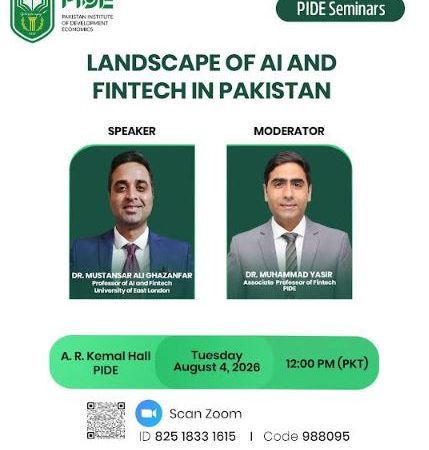
ISLAMABAD, AUG 4 /DNA/ – The Pakistan Institute of Development Economics (PIDE) organised a seminar titled “Landscape of AI and Fintech in Pakistan”, examining how artificial intelligence, financial technology and big-data analytics can improve economic policymaking while safeguarding public trust, institutional accountability and sensitive information.
The seminar featured Dr Mustansar Ali Ghazanfar, Associate Professor of Artificial Intelligence at the University of East London, while Dr Muhammad Yasir, Associate Professor of Fintech at PIDE, moderated the session. Dr Ghazanfar drew on his experience in AI strategy, responsible technology adoption, fintech research and institutional transformation to outline a practical pathway for Pakistan’s digital future.
Dr Ghazanfar said AI and fintech should be assessed through three interconnected principles: value, intelligence and accountability. AI can accelerate evidence gathering and policy research, while financial and administrative data can provide greater insight into economic activity. However, these benefits cannot create lasting institutional value without verified evidence, clearly assigned ownership and human approval.
He stressed that responsible AI adoption should begin with institutional needs rather than the purchase of technology. Before introducing any AI system, organisations should determine where it can create measurable value, what data it requires, what safeguards are necessary and who will remain accountable for its outputs. He noted that predictive, generative and agentic AI systems perform different functions and carry different risks; therefore, the level of oversight should correspond to the technology’s autonomy, the sensitivity of the data and the possible consequences of error.
The speaker urged institutions to move away from informal and fragmented use of AI towards governed workflows in which approved tools, documented evidence, human review and performance measurement are built into the process. He described AI transformation primarily as an institutional and cultural change involving people, processes and data, rather than a purely technical exercise.
Discussing Pakistan’s fintech landscape, Dr Ghazanfar acknowledged considerable progress in digital-payment infrastructure but cautioned that rising transactions and account registrations do not automatically translate into meaningful financial inclusion. Fintech success, he said, should be measured by active usage, affordability, consumer confidence, effective complaint resolution and whether digital services improve people’s financial resilience.
The presentation highlighted that Pakistan’s digital-payment infrastructure is advancing, while significant gaps remain in cross-border payments, independent access, consumer trust, digital readiness and evidence-based policy evaluation. Dr Ghazanfar argued that Pakistan’s international payment challenge is wider than the absence of PayPal, as exporters and freelancers also face onboarding difficulties, foreign-exchange costs, settlement delays and limited payment options.
He also emphasised that digital readiness remains unequal across gender, income and location. Reliable connectivity, affordable devices, financial literacy, privacy protection and secure complaint mechanisms are necessary to ensure that digital expansion benefits women, rural communities and lower-income citizens.
On the safe use of generative AI, Dr Ghazanfar warned institutions against entering unpublished research, confidential datasets, internal documents, financial records, donor communications or personal information into public AI platforms. He recommended classifying data according to its sensitivity and using private or secure environments for confidential material. AI may help researchers find sources, organise evidence and prepare initial drafts, but humans must verify every factual claim, assess policy trade-offs and retain final decision-making authority.
Dr Ghazanfar proposed that PIDE undertake a structured 90-day pilot involving one or two carefully selected AI-assisted research workflows. The process would include assigning ownership, classifying data, approving tools, training staff and evaluating citation accuracy, reproducibility, efficiency and potential risks before deciding whether wider adoption is justified.
The seminar concluded that Pakistan should not pursue technology merely for visibility or scale. Its priority should be measurable institutional value, stronger evidence, trusted digital services and clear human accountability. PIDE can contribute by independently evaluating fintech policies, supporting controlled data partnerships and developing responsible methods for AI-assisted economic research.
During the question-and-answer session, Dr Ghazanfar apprised the participants that Pakistan should encourage private-sector innovation through appropriate incentives, effective regulation and stronger public-private partnerships. He advised institutions not to restrict AI use altogether, as such an approach could prove counterproductive; instead, they should introduce clear policies, approved tools and institutional licences to enable responsible adoption. Given Pakistan’s limited resources, he also recommended prioritising practical AI applications and regional computing partnerships rather than making immediate, costly investments in large-scale data-centre infrastructure.
Related News

Naval chief reviews exercise SEASPARK 2026 at sea
RAWALPINDI, SEP 20 /DNA/ – Admiral Naveed Ashraf, NI, NI (M), T Bt, Chief ofRead More

Govt ‘exits’ electricity purchase system as first-ever power wheeling auction begins
ISLAMABAD, SEP 20: The federal government on Sunday sought Request for Proposals (RFPs) for Pakistan’sRead More
Comments are Closed