

Trump’s Hubris at the United Nations
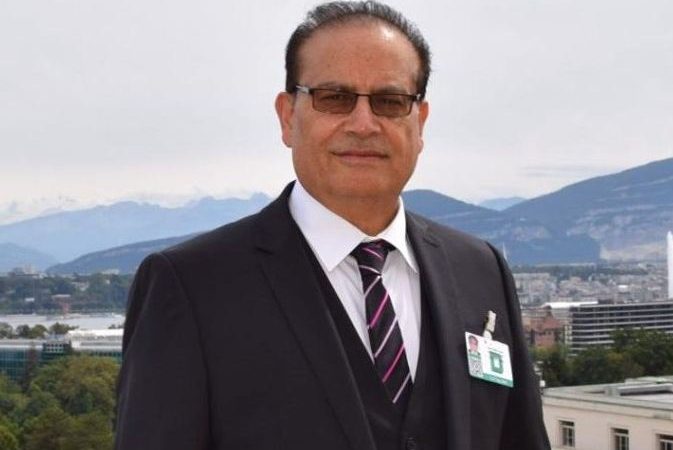
Qamar Bashir
Trump’s UN address and the international rejection surrounding Netanyahu exposed a world increasingly divided between the rule of law and the unrestrained exercise of power.
The United Nations was created after the Second World War to restrain power through law, replace war with diplomacy and give sovereign countries a voice. President Donald Trump’s address to the 81st General Assembly on September 22, 2026, presented a different conception of international order—one in which military dominance, economic control and national power appeared to take precedence over multilateral accountability.
Trump again credited himself with settling eight wars. Fact-checkers found the claim exaggerated: several cases involved temporary ceasefires, while at least two were not wars during his presidency. The continuing US–Iran conflict further complicated his peacemaking claim. His assertion of $21 trillion in new investment commitments also exceeded his administration’s published total of approximately $11.2 trillion, much of it consisting of nonbinding announcements.
The most consequential passage concerned Iran. Trump offered a choice between an agreement allowing Iran to rebuild and the rapid annihilation of the Islamic Republic. He spoke of driving it into a condition with no hope of survival. These words were delivered before the institution was established to prevent aggressive war and mass destruction.
Religious and ethical traditions differ, but humility, restraint and the protection of innocent life are central to many of them. Against that background, contemplating the destruction of an entire country represented the hubris of power, speaking as if it possessed authority over the survival of another civilization. A threat alone is not only a completed war crime, but implementing an indiscriminate campaign against Iran’s population or civilian infrastructure is also a grave violation of international humanitarian law.
Trump’s attack on the International Criminal Court reflected the same conflict over accountability. He called it an anti-American tribunal, described its officials in degrading language and urged all member states to withdraw. The United States is not a party to the Rome Statute, but the claim that the court can never exercise jurisdiction over Americans is incomplete. The ICC says nationals of nonmember states may fall within its jurisdiction when alleged crimes occur on a member state’s territory, when jurisdiction is accepted by the relevant state or after a Security Council referral.
Trump announced that artificial intelligence should be renamed “super intelligence” and rejected international controls. Yet superintelligence already means a hypothetical system exceeding human abilities. Hundreds of researchers and executives have warned that extreme AI risks deserve serious attention. AI offers remarkable benefits, but celebrating its power while dismissing its risks is not responsible governance.
Trump also mocked predictions of climate catastrophe. His administration withdrew from the Paris Agreement and, in January 2026, announced its departure from the UN Framework Convention on Climate Change. Scientists’ central finding is that human emissions are warming the planet and increasing serious risks. America’s withdrawal weakened action on a problem no border can contain
Other economic assertions required similar scrutiny. The official poverty rate declined to 10.2 percent in 2025, but the broader Supplemental Poverty Measure remained around 13.1 percent.
In the Strait of Hormuz, Trump described large numbers of ships moving through regularly, although shipping data recorded only 17 commodity vessels during the cited weekend—far below the prewar average of approximately 125 large commercial vessels per day. The gap between rhetoric and verifiable conditions ran throughout the address.
The most revealing issue, however, concerned Venezuela. Trump publicly said the United States was taking in “billions and billions of dollars” from that country. When asked about reports of $13 billion, he suggested the amount might be even greater and declared that the proceeds had repaid the cost of the American military operation many times over. He further indicated that the money could support the running of the United States, including its military.
Before the House Financial Services Committee, Treasury Secretary Scott Bessent described the broader Venezuelan arrangement as potentially “one of the largest assets ever to go on the U.S. balance sheet.” He confirmed American control over multiple Venezuelan assets but did not provide lawmakers with a complete total, identify every account or disclose all ultimate beneficiaries.
The central issue is not an accounting technicality but sovereignty and propriety. Venezuela is an independent country whose oil, gold, minerals and other natural resources belong to its people. When a foreign power takes control of revenue and national assets and then describes the arrangement as an asset on its own balance sheet, the boundary between custody and appropriation becomes impossible to ignore. Calling the arrangement management, protection or administration does not erase the reality that Washington determines how the wealth is held, valued and distributed.
Consider the reaction if Britain intervened in the United States, assumed control over American oil revenue, gold or strategic minerals and placed the resulting interests on the British balance sheet. Washington would never accept such an arrangement as benevolent stewardship. Imposing it upon Venezuela establishes an alarming precedent: military superiority allows the stronger country to control the resources and sovereign functions of the weaker one.
The administration maintains that Venezuelan funds remain Venezuelan sovereign property held in American custody. Yet that explanation sits uneasily beside Trump’s assertion that “we” are taking in the money, his claim that it repaid America’s war costs and Bessent’s reference to the US balance sheet. The absence of a complete public accounting makes the contradiction more serious. Whatever legal terminology is ultimately applied, Venezuelans—not foreign governments, corporations or financial intermediaries—should be the beneficiaries of Venezuela’s national wealth.
Trump’s conflict with the press added a constitutional dimension. CNN, MS NOW and Politico journalists were denied White House access, prompting major networks to suspend pooled coverage while the excluded organizations sought judicial relief. At the UN, Trump told CNN’s Kaitlan Collins that she should not be there. Viewpoint-based exclusion creates serious constitutional questions; a press free to question power remains indispensable to democratic accountability.
The widely circulated photograph of diplomats leaving Benjamin Netanyahu’s UN address tells another story. Representatives from more than 50 countries walked out as he defended Israel’s Gaza campaign and rejected genocide accusations. The ICC identifies him as allegedly responsible for war crimes, including starvation as a method of warfare.
The walkout documented Israel’s growing diplomatic isolation amid Gaza’s devastation and the continuing denial of Palestinian statehood. Israeli measures expanding control in the occupied West Bank have since been described by one Israeli minister as “de facto sovereignty.” Palestinians, Arab governments, the UN and human-rights organizations argue that settlement expansion further destroys the possibility of a viable two-state solution.
Trump and Netanyahu spoke at General Assembly sessions and faced similar controversies. What connected the two appearances was the same unresolved question: does military superiority place leaders beyond international scrutiny? One faced a mass diplomatic walkout. The other delivered threats and disputed claims that immediately provoked international criticism.
If international law binds only weaker countries, it ceases to function as law and becomes an instrument of power. If a sovereign nation’s assets can be controlled without transparent accounting, independence loses its meaning. If journalists are excluded for unfavorable reporting, democratic scrutiny narrows. The speeches and reactions surrounding Trump and Netanyahu revealed a world still struggling to decide whether power will remain answerable to law, ethics, sovereignty and humanity.
Qamar Bashir
Press Secretary to the President (Rtd)
Former Press Minister, Embassy of Pakistan to France
Former Press Attaché to Malaysia
Former MD, SRBC | Michigan, USA
Related News
Will Trump and Netanyahu Be Able to Overcome Their Political Challenges?
By: Muhammad Rafi The ongoing war in the Middle East is no longer merely aRead More

The Need for Building Truly Inclusive Classrooms for Visually Impaired Students
By: Ayla Danish Education is often called the key that unlocks potential and breaks downRead More
Comments are Closed