

Russian ambassador outlines vision for deeper Pakistan ties
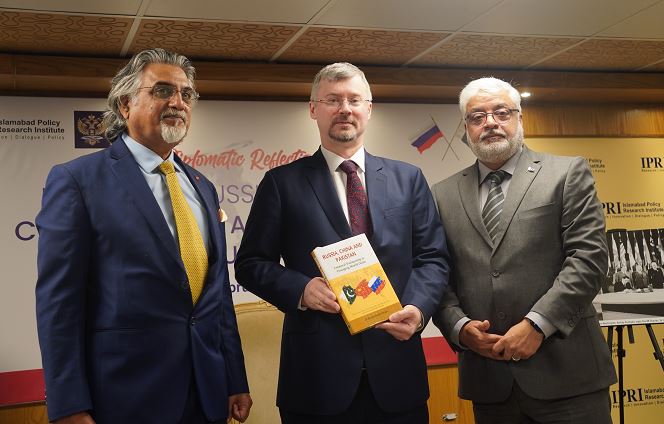
ISLAMABAD, FEB 9 /DNA/ – In a comprehensive address on the eve of Russia’s Diplomats’ Day, Ambassador Albert P. Khorev underscored the deep historical roots of Russian statecraft and outlined a robust vision for the future of Russia-Pakistan relations during a seminar at the Islamabad Policy Research Institute (IPRI).
The event, titled “Legacy of Russian Diplomacy. Current State and Prospects of Russia-Pakistan Relations,” was attended by IPRI President Lt General Majid Ehsan and other distinguished guests.
A Millennium of Diplomacy
Ambassador Khorev began by tracing the origins of Russian diplomacy back to the 9th century, highlighting key milestones such as the 860 Treaty of Peace and Love with the Byzantine Empire and the formal establishment of the Ambassadorial Service in 1549. He paid tribute to historical figures who shaped Russia’s international engagement, from the strategic compromise of Alexander Nevsky during the Mongol period to the foundational work of Ivan Viskovaty.
The Ambassador detailed the contributions of several prominent foreign ministers, including:
- Vasily Golitsyn (1682-1689): Credited with securing the “Eternal Peace” with Poland-Lithuania and the first Sino-Russian border treaty.
- Andrei Osterman: A key architect of the Treaty of Nystad (1721), which secured Russia’s access to the Baltic Sea.
- Alexander Gorchakov (19th Century): Famous for declaring “Russia is concentrating” and for abolishing restrictive clauses of the 1856 Paris Treaty.
- Andrei Gromyko (1957-1985): Noted for his pivotal role in founding the UN and managing Cold War crises. Ambassador Khorev specifically highlighted Gromyko’s role in establishing diplomatic relations between the USSR and Pakistan on May 1, 1948, and the USSR’s mediation leading to the 1966 Tashkent Declaration between Pakistan and India.
- Yevgeny Primakov (1996-1998): Associated with Russia’s turn toward a “multi-vector” foreign policy, famously exemplified by his decision to turn his plane back over the Atlantic in 1999 to protest NATO’s bombing of Yugoslavia.
A Flourishing Modern Partnership
Turning to contemporary ties, Ambassador Khorev stated that the friendship between Russia and Pakistan “is growing stronger every year.” He outlined several pillars of the current bilateral relationship:
- High-Level Political Dialogue: Noting two meetings between the countries’ leaders in 2025 and three between their foreign ministers, he emphasized a “dynamic and constructive” political dialogue.
- International Coordination: Close cooperation at the UN and SCO, with shared commitments to a multipolar world order, combating terrorism, extremism, neo-colonialism, and Islamophobia.
- Trade & Economic Projects: Several promising initiatives are under discussion, including:
- Restoring the Karachi Steel Mills.
- Launching railway connectivity via the North-South Transport Corridor.
- Joint pharmaceutical production (including insulin).
- Development and modernization of Pakistan’s hydropower sector and oil/gas fields.
- Working on alternative payment mechanisms to bypass Western sanctions.
- Humanitarian & Educational Ties: Russia has tripled scholarships for Pakistani students to 152 for the 2025-26 academic year. Russian language centers are active, and both sides are exploring involvement in the “Russian Teacher Abroad” program.
- Institutional Framework: The Intergovernmental Commission (IGC), Business Council, and regular diplomatic consultations provide a solid foundation for cooperation.
The Ambassador also suggested Pakistan explore engagement with BRICS and its New Development Bank, as well as with the Eurasian Economic Union (EAEU).
A Commitment to the Future
Concluding his remarks, Ambassador Khorev reaffirmed Russia’s foreign policy priorities: upholding the UN Charter, building a multipolar world, combating neo-Nazism and neo-colonialism, and preserving historical truth. He expressed confidence in the continued growth of the Russia-Pakistan strategic partnership, stating, “We will continue working to realize the full potential of Russia-Pakistan relations.”
The seminar, which also featured an exhibition on the history of Russian diplomacy, concluded with a Q&A session.
Related News
Romania unveils first choral arrangement of Pakistan’s anthem
ISLAMABAD, MAR 22 /DNA/ – In a historic cultural gesture marking Pakistan Day, the EmbassyRead More
Uzbek envoy extends Eid ul-Fitr greetings to nation
ISLAMABAD, Mar 20 (DNA): The Ambassador Extraordinary and Plenipotentiary of Uzbekistan to the Islamic RepublicRead More
Comments are Closed