

Pakistan religious, political groups back Saudi security, Haramain protection
Islamabad declaration condemns Houthi attacks, expresses solidarity with the Yemeni people, backs Pakistan-Saudi Arabia-Turkiye defence cooperation, and pays tribute to Field Marshal Asim Munir’s peace efforts
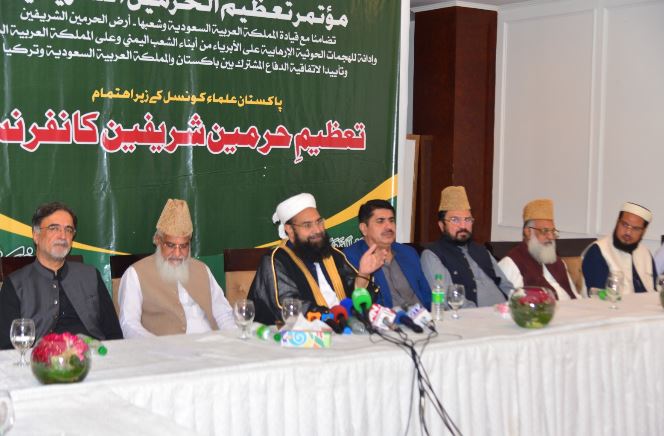
ISLAMABAD, OCT 21 /DNA/ – The Tazeem-e-Haramain Sharifain Conference, jointly organised by the Pakistan Ulema Council and the International Tazeem-e-Haramain Sharifain Council, has unanimously reaffirmed its commitment to protecting the sanctity of Makkah al Mukarramah, Madinah al Munawwarah and the two holy mosques, while expressing full solidarity with the Kingdom of Saudi Arabia in safeguarding its security, sovereignty and stability.
The conference, held under the dynamic leadership of the Chairman of the Pakistan Ulema Council, Secretary-General of the International Tazeem-e-Haramain Sharifain Council and Coordinator of the National Paigham-e-Aman Committee, Hafiz Muhammad Tahir Mehmood Ashrafi at a local hotel in Islamabad, brought together religious scholars and spiritual leaders from different schools of thought, leaders of political and religious parties, and representatives from various walks of life including the diplomatic core.
Among the prominent personalities including Pakistan Peoples Party’s leader Qamar Zaman Kaira, Shamsher Khan Mazari, Maulana Muhammad Amal Ludhianvi, Syed Ziaullah Shah Bukhari, Mufti Abu Muhammad, Maulana Nauman Hashir, Maulana Iqbal Qadri, Maulana Asif Munir, Mufti Abdul Karim, Maulana Tahir Aqeel, Maulana Zulfiqar Ahmed, Mufti Abdul Rehman Madani, Maulana Aslam Siddiqui, Maulana Zahid Qasmi, Maulana Sultan Mahmood Zia, Maulana Aftab Nazir, Maulana Qari Abdul Hakeem Attar, Mufti Umar Farooq, Maulana Abdul Hadi, and Maulana Naib Khan graced the event with their presence and spoke on the occasion.
The joint declaration stated that the protection of Haramain Sharifain, the security of Saudi Arabia, unity within the Muslim Ummah and the protection of oppressed people were shared religious, national and humanitarian responsibilities.
They also paid tribute to Field Marshal Syed Asim Munir for his efforts to promote peace, unity and solidarity within the Muslim Ummah, and to advance international peace. They appreciated his role in supporting initiatives for strengthening unity among Muslim countries and promoting peace and stability at the regional and global levels.
They expressed strong support for the Government of Pakistan’s efforts to safeguard Saudi Arabia’s security and sovereignty, protect Haramain Sharifain and strengthen regional peace. They emphasised the importance of Pakistan’s diplomatic engagement, defence cooperation and constructive role in promoting stability and unity across the Muslim world.
The religious scholars and leaders described the sanctity of Makkah al-Mukarramah, Madinah al-Munawwarah, the Holy Kaaba and Masjid-e-Nabawi (Peace Be Upon Him) as an integral part of every Muslim’s faith and belief.
They stated that the security and protection of the two holy mosques were not the responsibility of any single country or nation but a collective religious duty of the entire Muslim Ummah.
The religious scholars and leaders stressed that no compromise could be made on the safety of the holy sites, visitors to the Holy Kaaba, and pilgrims arriving to perform Hajj and Umrah.
They strongly condemned attacks by the Houthi armed group targeting Saudi Arabia, civilian populations, airports, critical infrastructure and visitors.
According to the declaration, taking innocent lives, attacking civilian installations, spreading fear and threatening the security of sacred places were contrary to Islamic teachings, international humanitarian law and fundamental human values.
The Ulema demanded the immediate and unconditional cessation of all such attacks and called for effective measures to ensure civilian protection.
They expressed complete solidarity with the Kingdom of Saudi Arabia under the leadership of the Custodian of the Two Holy Mosques, King Salman bin Abdulaziz, and Crown Prince and Prime Minister Mohammed bin Salman.
They reaffirmed support for Saudi Arabia’s security, sovereignty, territorial integrity and stability, as well as for its legitimate defensive measures, in accordance with international law, to protect Haramain Sharifain, civilian populations and national security.
They also reiterated the commitment of the people of Pakistan, religious scholars, spiritual leaders, and political and religious parties to further strengthening the bonds of brotherhood, affection and solidarity with the people of Saudi Arabia.
The leaders emphasised that the Houthi armed group must not be equated with the people of Yemen, describing the Yemeni people as brothers and sisters in both religious and humanitarian terms.
They clarified that the conflict in Yemen must be understood as a conflict involving the internationally recognised Yemeni government and the Houthi armed group, and must not be portrayed as a Shia-Sunni or sectarian conflict. They stressed that the crisis had no justification for being framed in sectarian terms and that the Muslim Ummah did not regard it as a dispute between religious schools of thought.
They stated that the Houthi armed group and the people of Yemen were distinct and must not be treated as one and the same. They reiterated that the people of Yemen were brothers and sisters who deserved peace, dignity, security and humanitarian assistance.
The leaders noted that prolonged conflict, insecurity, hunger, displacement, economic devastation and the lack of basic facilities had placed the Yemeni population under severe hardship.
They expressed full solidarity with the people of Yemen and called for unimpeded humanitarian assistance, including food, medicines, clean water, healthcare and education.
They also reaffirmed support for Yemen’s unity, sovereignty, territorial integrity and the Yemeni people’s right to peace and security.
The religious scholars and leaders endorsed defence cooperation, mutual security arrangements and joint defence initiatives among Pakistan, Saudi Arabia and Turkiye.
They stated that the fundamental purpose of defence cooperation among Muslim countries should be to deter aggression, protect sacred places, respect national sovereignty and strengthen peace and stability in the region.
They said cooperation among the three countries could promote mutual trust, collective security and shared responsibility among Muslim nations.
They stressed, however, that such cooperation should be based on defence, peace, security and stability rather than aggression against any nation or country.
The Ulema and Mashaikh supported the diplomatic and defence cooperation undertaken by the Government of Pakistan to safeguard Saudi Arabia’s security and sovereignty and protect Haramain Sharifain.
They described the historic, religious, fraternal and defence ties between Pakistan and Saudi Arabia as being of special importance to the people of both countries.
They also appreciated the efforts of Pakistan’s armed forces and national security institutions in defending the country, promoting regional peace and fulfilling international responsibilities.
They reaffirmed its support for all sincere efforts for strengthening unity and solidarity among Islamic countries and promoting cohesion within the Muslim Ummah. They called upon Muslim leaders, governments, religious scholars and institutions to work collectively for peace, mutual understanding and the protection of shared religious and humanitarian interests.
They also addressed the question of negotiations with armed groups accused of killing innocent people and carrying out attacks against civilians. It stressed that dialogue and political solutions must lead to genuine and sustainable peace and must not become a means of legitimising violence or allowing armed groups to continue their activities without accountability.
The leaders questioned how meaningful negotiations could take place with groups that had killed innocent people without a clear commitment to ending violence, accepting responsibility for their actions and demonstrating remorse for past conduct.
They maintained that no armed group should be allowed to endanger innocent people, civilian populations or sacred places while using negotiations to prolong attacks or facilitate further armed operations.
In this context, they opposed any approach that would allow groups such as the Houthis, the Balochistan Liberation Army (BLA), Fitna al-Khawarij, Fitna al-Hindustan or other armed groups operating in Muslim countries to use negotiations as a cover for continued violence against innocent people.
They emphasised that the principle should apply consistently to all armed groups, irrespective of their identity or location. They called for an end to attacks on civilians, respect for the law and credible commitments to peace as essential conditions for any meaningful political process.
The leaders acknowledged the importance of negotiations and political solutions in achieving lasting peace in the region. However, they maintained that dialogue must be based on ending attacks against civilians, bringing violence to an end, respecting international obligations and implementing credible peace measures.
They emphasised that the purpose of negotiations must be to achieve genuine and sustainable peace, not to justify or provide cover for armed aggression.
They appealed to Muslim leaders, religious scholars, spiritual leaders, religious institutions and Islamic organisations to play a joint and effective role in protecting the sanctity of Haramain Sharifain, safeguarding the security of Muslim countries, addressing the humanitarian suffering of the Yemeni people and establishing regional peace.
They urged the Organisation of Islamic Cooperation (OIC), the Muslim World League and other relevant international institutions to take practical measures to protect civilians, facilitate humanitarian assistance and reduce regional tensions.
The scholars stressed that the crisis in Yemen and the prevailing regional tensions must not be used as a pretext for spreading hatred against any religious school of thought, nationality or community.
They condemned sectarian incitement, baseless information and hate campaigns on social media, urging religious scholars and spiritual leaders to promote Muslim unity, moderation and mutual respect.
The leaders called upon the United Nations, the international community and relevant human rights institutions to play an effective role in protecting civilians, visitors, religious sites and critical infrastructure.
They also urged intensified diplomatic efforts to end the humanitarian crisis in Yemen, rehabilitate affected communities and achieve a lasting political settlement.
The Ulema and Mashaikh and religious and political leaderships pledged to continue fulfilling their religious, academic, social and national responsibilities to protect Haramain Sharifain, strengthen brotherly relations between Pakistan and Saudi Arabia, promote unity within the Muslim Ummah and support peace in Yemen.
They said awareness would be promoted through mosques, seminaries, religious institutions and public gatherings regarding peace, brotherhood, respect for sacred places and the protection of innocent lives.
Concluding the declaration, they reaffirmed that the protection of Haramain Sharifain was an unshakeable commitment rooted in faith, and that solidarity with Saudi Arabia’s security and stability remained unwavering.
They declared that attacks by the Houthis or any other armed group against civilians, visitors and sacred places were unacceptable.
They reiterated that the people of Yemen were brothers and that ending their suffering and achieving lasting peace in the country remained a shared aspiration.
They also reaffirmed support for defence cooperation between Pakistan, Saudi Arabia and Turkiye and for collective security efforts among Muslim countries.
The conference concluded with prayers for the protection of Haramain Sharifain, peace and stability in Saudi Arabia, Pakistan and all Muslim countries, an end to the suffering of the people of Yemen, and unity and harmony throughout the Muslim Ummah.
Related News
Maldives President commends professionalism of Pakistan’s Armed Forces
RAWALPINDI, OCT 21 /DNA/ – Field Marshal Syed Asim Munir, NI (M), HJ, Chief ofRead More

Pakistan, Latvia hold 7th round of bilateral political consultations
ISLAMABAD, OCT 21 /DNA/ – Pakistan and Latvia held the 7th Round of Bilateral PoliticalRead More
Comments are Closed