

Middle East conflict could disrupt remittances and trigger return of Pakistani workers, PIDE Study
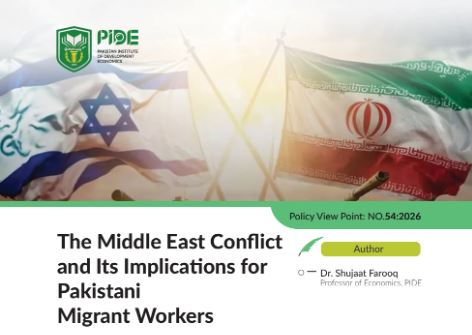
ISLAMABAD, MAR 16 /DNA/ – The Pakistan Institute of Development Economics (PIDE) has released a new policy brief highlighting the potential economic and labour market consequences of the ongoing Middle East conflict for Pakistan. The study, titled “The Middle East Conflict and Its Implications for Pakistani Migrant Workers,” authored by Dr. Shujaat Farooq, Professor of Economics and Dean of Research at PIDE, warns that prolonged instability in the region could significantly disrupt overseas employment opportunities and remittance inflows that are vital to Pakistan’s economy.
According to the policy brief, Pakistan’s economic stability is closely tied to the Middle East labour market, which hosts approximately six million Pakistani workers and accounts for more than half of the country’s total remittances. Each year, nearly 700,000 to 800,000 Pakistanis migrate to the region for employment. However, escalating geopolitical tensions could reduce labour outflows and trigger large-scale return migration, placing additional pressure on Pakistan’s already strained domestic labour market.
The study estimates that if the conflict persists, around half a million new workers may not be able to migrate to the Middle East in 2026, while a similar number of existing migrants could be forced to return home. Such a scenario would significantly impact labour markets, particularly in provinces like Khyber Pakhtunkhwa and Punjab, where overseas migration traditionally absorbs a substantial share of new labour entrants.
Remittances, which currently contribute nearly 10 percent to Pakistan’s GDP and have grown from about $1 billion two decades ago to nearly $40 billion today, could also face a decline of $3–4 billion annually if the conflict continues. A reduction of this magnitude could put pressure on Pakistan’s exchange rate, widen the current account deficit, and weaken the country’s overall economic stability.
The policy brief also highlights the broader economic risks associated with prolonged conflict in the Middle East, including rising energy prices, disruptions in trade routes, and increased inflationary pressures. Approximately 11 percent of Pakistan’s exports are destined for Middle Eastern markets, regional instability could further complicate Pakistan’s external sector performance.
PIDE emphasizes that while overseas migration has historically provided relief to Pakistan’s labour market by absorbing a significant portion of new workers entering the labour force, excessive reliance on a limited number of destination countries exposes the economy to external shocks. Over the past decade, nearly 90 percent of officially documented Pakistani migrant workers have been employed in Gulf Cooperation Council (GCC) countries, with Saudi Arabia and the United Arab Emirates serving as the primary destinations.
To mitigate potential risks, the study recommends immediate policy measures to support Pakistani workers in the Middle East and to prepare for possible return migration. These include strengthening diplomatic engagement with Gulf countries to safeguard workers’ rights, establishing dedicated support portals for overseas Pakistanis, and developing comprehensive reintegration programs to assist returning migrants in finding employment or starting businesses.
In the longer term, PIDE underscores the importance of diversifying Pakistan’s overseas labour destinations beyond the Middle East. Expanding migration opportunities in East Asia, Australia, and other emerging labour markets, alongside investing in globally competitive skills development programs, could help reduce the country’s vulnerability to regional crises and ensure greater economic resilience.
The policy brief concludes that while Pakistan has made progress in stabilizing its economy under ongoing reforms, external shocks such as geopolitical conflicts can quickly undermine these gains. Proactive policy planning, labour market diversification, and stronger institutional support for migrant workers will therefore be essential to safeguard Pakistan’s economic stability in the years ahead.
Related News

Qatar’s Minister commends Pakistan’s constructive role in fostering peace
ISLAMABAD, Apr 8: Deputy Prime Minister and Foreign Minister Senator Mohammad Ishaq Dar on WednesdayRead More

ECC approves Rs 2.8 billion for child immunization
ISLAMABAD, APR 8 /DNA/ – The Economic Coordination Committee (ECC) of the Cabinet met todayRead More
Comments are Closed