

March 31 Genocide – A crime against humanity committed against Azerbaijanis
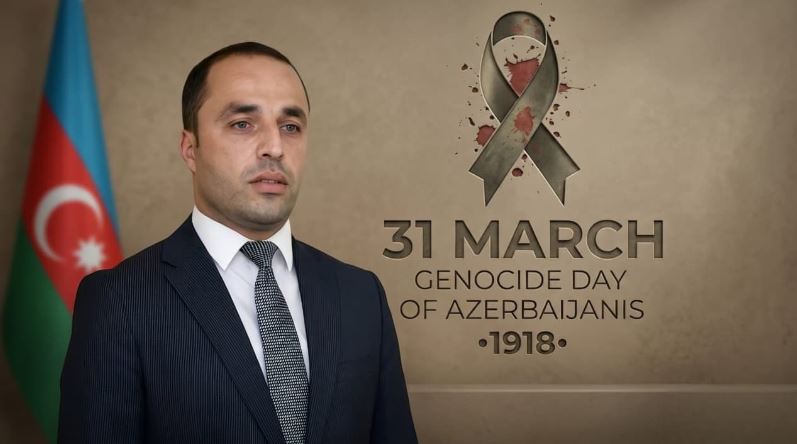
Farid MUSTAFAYEV
Starting from the early 18th century, Armenian nationalists carried out a policy of genocide against the Azerbaijani people. During that period, Tsarist Russia, which was expanding its territories toward the South Caucasus, used Armenians as a tool and encouraged them with the promise of establishing an Armenian national state in the region.
According to a decree issued on November 10, 1724, in the name of Peter I, favorable conditions were to be created for the resettlement of Armenians in the newly occupied territories, including Baku and other areas.
Taking advantage of this opportunity, Armenians pursued their insidious policies and committed massacres against Azerbaijanis in various regions in an attempt to establish an Armenian state on the historical lands of Azerbaijan. As a result of this systematic and deliberate policy of genocide, thousands of innocent Azerbaijanis were brutally killed, their homes were burned, and their property was looted.
It should be noted that although Armenians constituted a minority in the territories where they were resettled, they managed, with the support of their patrons, to establish administrative units. Thus, the foundation was laid for the policy of expelling and annihilating Azerbaijanis from their own lands.
In order to legitimize the fabricated idea of a “Greater Armenia,” Armenian history was falsified, while Azerbaijan’s history was distorted. In the 20th century, Armenian aggressors, inspired by such artificial ambitions, carried out even more brutal acts of violence against Azerbaijanis.
As a result, atrocities that began in Baku spread throughout the entire territory of Azerbaijan. Thousands of Azerbaijanis were brutally killed, and hundreds of settlements were destroyed. The first large-scale massacres against Azerbaijanis in the 20th century, driven by the illusion of “Greater Armenia,” occurred in 1905–1907.
During that time, thousands of Azerbaijanis were mercilessly killed by Armenians in Baku, Nakhchivan, Zangezur, Iravan, and other historical Azerbaijani lands.
Between December 1917 and March 1918, under the leadership of Andranik, Armenian armed units actively participated in the destruction of Azerbaijani villages. In the Iravan district, 32 villages; in Echmiadzin district, 84 villages; and in Nor-Bayazid district, 7 villages were destroyed—197 villages in total.
Many residents were killed, while others were displaced from their homes, their property looted, and their houses completely demolished. Armenians began to realize their ambitions under the banner of Bolshevism. In March 1918, Stepan Shaumyan was appointed Extraordinary Commissar of the Caucasus and sent to Baku.
From that moment, under the slogan of “struggle against counter-revolutionary elements,” the Baku Commune, led by Shaumyan and supported by Dashnak-Bolshevik forces, initiated a plan to cleanse Baku of its Azerbaijani population.
When discussing the genocide against Azerbaijanis, particular attention is given to the massacres carried out in March 1918 in Baku, Shamakhi, Quba, Goychay, Kurdamir, Salyan, Lankaran, and other regions. Between March 30 and April 3, 1918, armed Armenian units affiliated with the Baku Soviet and the Dashnaktsutyun party committed mass killings against Azerbaijanis in Baku and across various regions, including Karabakh, Nakhchivan, Shamakhi, Quba, Khachmaz, Lankaran, Salyan, Zangezur, and others. According to official sources, nearly 12,000 Azerbaijanis were killed, tens of thousands went missing, and settlements, historical monuments, mosques, and cemeteries were destroyed. Beginning on March 31, 1918, mass killings of Azerbaijanis in Baku intensified.
Around 6,000 armed soldiers of the Baku Soviet and 4,000 armed members of the Dashnaktsutyun participated in the massacres. Over the course of three days, Armenian armed groups, with Bolshevik support, carried out sudden attacks on Azerbaijani neighborhoods, killing people indiscriminately—men, women, and children alike. In 1925, a German witness named Kulner described these events, stating that Armenians entered Muslim (Azerbaijani) neighborhoods, killing everyone, mutilating bodies, and committing acts of extreme brutality without sparing children or the elderly.
After the establishment of the Azerbaijan Democratic Republic in 1918, special attention was given to investigating the March events. On July 15, 1918, the Council of Ministers established an Extraordinary Investigation Commission. According to its findings, Armenian armed groups killed up to 8,000 civilians in Shamakhi alone. Entire villages were destroyed in various districts, including Jabrayil and Javanshir. Near Gyumri, a convoy of 3,000 Azerbaijanis—mostly women, children, and elderly—was ambushed and completely annihilated.
In Zangezur, 115 Azerbaijani villages were destroyed, and over 10,000 Azerbaijanis were killed or injured, while 50,000 were displaced. In the Iravan province, 135,000 Azerbaijanis living in 199 villages were killed, and the villages were razed to the ground. Between 1918 and 1920, Armenian armed groups also destroyed 150 villages in the mountainous part of Karabakh.The Azerbaijan Democratic Republic declared March 31 a national day of mourning in 1919 and 1920.
The systematic study and international recognition of these tragic events were later advanced under the initiative of national leader Heydar Aliyev. By a decree dated March 26, 1998, March 31 was officially declared the “Day of Genocide of Azerbaijanis.” Since then, significant efforts have been made to study this tragedy, publish research, and translate materials into foreign languages. One of the most tragic episodes of this genocide is the mass grave discovered in the city of Quba on April 1, 2007, during excavation work. Investigations revealed that in April–May 1918 alone, 167 villages in the Quba district were completely destroyed.
In 2009, the Cabinet of Ministers approved a plan to commemorate the victims, leading to the construction of a memorial complex at the site. On September 18, 2013, the Quba Genocide Memorial Complex was officially opened. Research has shown that along with Azerbaijanis, representatives of other ethnic groups living in the region—such as Lezgis, Jews, Tats, and others—were also brutally killed and buried in the mass grave. On January 18, 2018, President Ilham Aliyev signed a decree marking the 100th anniversary of the 1918 genocide of Azerbaijanis.
According to the decree, the centenary was widely commemorated not only in Azerbaijan but also by Azerbaijani diaspora organizations and embassies around the world. Articles and materials were published in the media to raise international awareness about the crimes committed by Armenian-Bolshevik armed groups against Azerbaijanis.
Farid MUSTAFAYEV
Deputy Chairman of the Territorial Party Organization of YAP Yasamal District under the Ministry of Science and Education at the Institute of Soil Science and Agrochemistry, Member of the Western Azerbaijan Community.
Related News

March 31 Genocide – A crime against humanity committed against Azerbaijanis
Farid MUSTAFAYEV Starting from the early 18th century, Armenian nationalists carried out a policy ofRead More

Iran vs U.S.: When Demands Collide, Can Peace Survive?
Qamar Bashir The Middle East today is not witnessing a single war, but a convergenceRead More
Comments are Closed