

HEC displays over 100 tech solutions
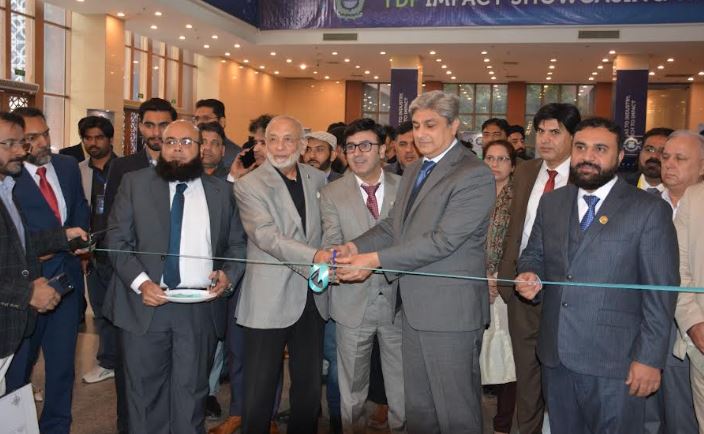
ISLAMABAD, DEC 31 /DNA/ – The Higher Education Commission (HEC), Pakistan organised TDF Impact Showcasing (TIS’25) to put on display over 100 successful projects completed under Technology Development Fund (TDF), one of its flagship research and development initiatives.
The exhibits included innovations made in vital areas of Health, Agriculture, Biotechnology, Engineering, Energy Systems, Environmental Management, and Emerging Technologies. It is pertinent to mention here that out of 238 projects awarded under the Fund, 192 have been completed while the rest are in their execution phases.
The daylong exhibition was aimed at projecting the impact of TDF, providing a platform for policymakers, academic brains, and industry professionals to witness ideas translating into solutions, and encouraging the innovating partners. The event brought together Government representatives, academia and industry leaders, entrepreneurs, and development partners for panel discussions and a fireside conversation.
In his address, Chairman HEC Mr. Nadeem Mahbub termed TIS’25 as a testimony to the HEC’s belief that the future of Pakistan lies in the potential of a robust collaborative bridge between academia and industry. He revealed that the mission of TDF is to transform ideas into market-ready solutions and empower the universities to become engines of socio-economic development. The initiative, he underlined, has become one of the success stories as it has not only nurtured the spirit of innovation across the country’s higher education institutions, but has also strengthened Pakistan’s Triple Helix Model, bringing together the government, industry, and academia for technology-driven development.
Highlighting the project achievements, the Chairman said that 116 patents have so far been filed under the initiative, and 25 of the filed patents have already been granted. He added that 48 trademarks and copyrights have been filed and 13 have already been granted under the project, in addition to development of 177 products and prototypes, signing of 162 technology licenses, and 18 emerging start-ups and spin-offs. He maintained that TDF led to 330 research publications, including 241 in impact factor journals. More than 5,600 professionals have been trained under the project, building a future-ready workforce, he added.
“These achievements are not just numbers, they represent stories of perseverance, collaboration, and belief in Pakistan’s potential,” he asserted, urging all the stakeholders to build new partnerships, scale promising technologies, and together shape a robust innovation ecosystem.
Sharing his insight, Chairman Rastgar Group of Companies Mr. Imtiaz Ali Rastgar underlined the significance of technology in the human life while exemplifying technological advancement across the world. He emphasised the need for unabated consistency in the execution of innovative technological projects for incessant progress. He expressed his satisfaction over the continuing efforts, through HEC’s initiatives such as Offices of Research, Innovation and Commercialization (ORICs) and Business Incubation Centres (BICs), to strengthen university-industry linkages and materialise problem-solving research. He noted that universities have a great role to play in removing the hurdles lying in industrial development and commercial activism in the urban as well as rural setups. He pointed out tangible measures such as improvement in the syllabi of business and entrepreneurship education, strengthened role of business schools in research selling, and profiling of students towards entrepreneurship, and development of export enhancement skills among business education students, to further consolidate the academia-industry linkages and yield more effective outcomes. Devising a national strategy is a need of the hour to address the gaps, he concluded.
In his remarks, Executive Director HEC Dr. Zia Ul Haq reiterated HEC’s commitment to bridging academia with industry, providing a pathway to develop products crucial for socio-economic development of the country. He extended gratitude to the government representatives, industry professionals, and researchers and innovators from the academia for gracing the showcasing event. “HEC urges the industry to open its doors to academia, as the secret of socio-economic development of a country lies in working in tandem,” he emphasised. He noted that Pakistan’s innovation future depends on strong Triple Helix synergy, robust industry-academia partnerships, and consistent, well-aligned policy implementation.
Advisor Research & Innovation (R&I) Division Dr. Muhammad Ali Nasir said on the occasion that TDF stands as one of the HEC’s most visionary initiatives, designed to translate academic research into tangible socio-economic impact. He said the project aims to bridge the long-standing gap between academia and industry by enabling universities to move beyond publications towards prototypes, products, patents, and commercially viable enterprises aligned with national priorities. He said that HEC has prepared PC-I of the TDF Phase-II, which will soon be presented before the Government.
TDF was launched in 2016 under PSDP with an initial budget of Rs. 2.9 billion, was established to facilitate knowledge and technology transfer from academia to industry through the development of prototypes, products, and processes. As a first programme of its kind in Pakistan, TDF has served as a platform for transforming academic innovation into revenue-generating ventures while fostering industry-academia collaboration. In recognition of its success and impact, the initiative has been extended until June 2027.
Related News
Turkish varsities to strengthen collaboration in emerging areas with Pakistan
ISLAMABAD, MAR 31 /DNA/ – A delegation of Turkish universities, led by Ambassador of Türkiye to Pakistan İrfan Neziroğlu, visited theRead More
Turkish University Fair 2026 to Be Held in Islamabad and Lahore
DNA Islamabad – The Turkish University Fair 2026 is scheduled to take place in IslamabadRead More
Comments are Closed