

Cambodia, Thailand trade veiled barbs at UNSC debate
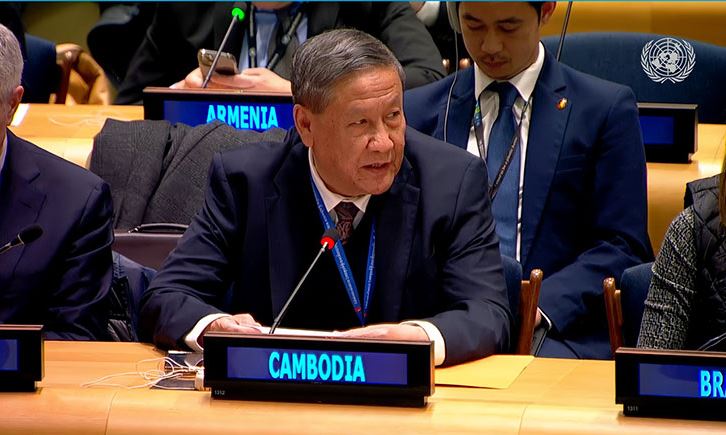
SYNPOSIS, JAN 28: Cambodia’s Permanent Representative to the UN Keo Chhea says Kingdom’s sovereignty is preserved by the international rule of law.
At an open debate at the UN Security Council (UNSC), estranged neighbours Cambodia and Thailand avowed compliance with international law—a principle also championed by regional bloc ASEAN—but did not forget to indirectly target one another over a festering border dispute.
The UNSC debate on Monday was organised under the agenda, “The promotion and strengthening of the rule of law in the maintenance of international peace and security.” Led by Somalia as the president, the forum aimed to “reaffirm the importance of the international rule of law for the maintenance of peace and security in the world and to identify ways and means of fortifying it and preventing its gradual erosion through breaches and violations.”
Earlier during the debate, the Philippines’ UN Permanent Representative, Enrique Manalo, delivered his statement on behalf of his country in its capacity as the current rotating ASEAN Chair.
“We affirm our commitment to the declaration and principles of international law concerning friendly relations and cooperation among states in accordance with the UN Charter,” he said.
“We also continue to promote the rule of law in all its aspects and affirm our commitment to peace and security, good governance and the promotion and protection of human rights enshrined in the ASEAN Charter.”
Thai Ambassador to the United Nations Cherdchai Chaivaivid speaks at the debate. UNSC
“In this regard, ASEAN reaffirms the importance of upholding international law, including the UN Charter and the 1982 UNCLOS, as well as ASEAN’s shared values and norms enshrined in the ASEAN Charter and the Treaty of Amity and Cooperation in Southeast Asia, among others.”
He added that ASEAN remained committed to strengthening its community and the peaceful resolution of disputes, including through the respect for legal and diplomatic processes, without resorting to the threat or use of force, in accordance with the universally recognised principles of international law.
In his remark, Cambodia’s Permanent Representative to the United Nations Keo Chhea expressed the Kingdom’s alignment with the notion presented by the ASEAN Chair. He highlighted that strict adherence to international legislation is more important than ever, given that its authority is being “tested” in the contemporary global setting.
Chhea also noted that the international rule of law for Cambodia is the very condition upon which sovereignty, territorial integrity, and equality of state are preserved. He also cited and called for absolute compliance with Article 2.4 of the UN Charter, which entails the prohibition of the threat or use of force against the territorial integrity of any state.
“Actions that seek to alter the status quo on the ground constitute a clear violation of international law and the risk of escalating tensions,” he said. “Cambodia emphasises that the peaceful settlement of disputes, as required by Article 2.3 of the Charter, is a binding legal obligation.”
The Cambodian PR also stressed that border and territorial disputes demand resolutions exclusively through peaceful and lawful means.
“Judicial settlement, including recourse to the International Court of Justice (ICJ), is a credible and principled pathway available to states,” Chhea added. “Cambodia calls for the effective and strengthened implementation of the Security Council Resolution 2788 of 2025, which reaffirms the mechanism for the peaceful settlement of disputes and preventive diplomacy.”
Prevention, according to Chhea, remains the most humane, cost-effective and legally sound investment an international community can make. Based on this principle, he explained that a visible and capable UN presence on the ground politically, financially, and operationally is essential not only for the de-escalation but also for the prevention of disputes.
Chhea also addressed the international humanitarian law, describing the legislature as an “essential and inseparable component of the international rule of law.”
“Civilian life must be protected in all circumstances,” he added. “Acts of aggression involving the targeting of civilians, the destruction and pillaging of civilian property, the obstruction of civilian return, the illegal occupation of territory, and the damage or destruction of cultural heritage constitute a breach of international humanitarian law.”
Speaking later in the same venue, Chhea’s Thai counterpart at the UN, Cherdchai Chaivaivid, also gave a similar statement. He said Thailand is deeply concerned by the growing reliance on power projection and unilateral actions for the undermining of the already weakened international order.
“At this difficult time, redoubling our collective efforts to uphold and protect the international rule of law is imperative,” he said.
Thailand underscored that the international rule of law is fundamental to maintaining global peace and security by enabling peaceful dispute resolution and restraining the use of power; that accountability is essential to prevent impunity and ensure international law is applied impartially without exceptions; and that upholding the rule of law is a shared global responsibility requiring collective commitment across regions and political divides.
“Only through genuine multilateral cooperation, mutual accountability and good faith engagement can we preserve the credibility of the international rule of law and ensure that rules rather than might govern international relations,” Cherdchai added.
Without the adherence and upholding of international rule of law, the Thai PR said, peace cannot endure, international justice becomes selective and multilateralism loses its credibility.
“The principles of sovereign equality, territorial integrity and the political independence of any state must be upheld in practice, not merely invoked in rhetoric,” he added. “Those who consistently call on others to respect international law must themselves adhere to it fully and in good faith.”
While both the Cambodian and Thai representatives appeared to support the principle mentioned by the Philippines during the debate, it was clear that the two of them were attacking one another directly. Cambodia’s remarks allude to Thailand’s actions along Cambodian territory, while Thailand’s statement responded accordingly.
Youk Chhang, Director of the Documentation Centre of Cambodia, described Thailand’s statement at the UNSC debate as a hypocrisy, considering its multiple illegal encroachments into Cambodia in the past seven months as well as the Thai military’s illegitimate occupation of Cambodia’s territory.
“Thailand militarily occupies 14 different areas of Cambodia, which is inconsistent with these US-brokered ceasefire agreements,” he said. “This issue is Thailand’s indifference and even violations of the US-brokered ceasefire agreement.
Related News
Iran president backs delegation ahead of Islamabad Talks
ISLAMABAD, APR 11: Iranian President Masoud Pezeshkian has said that regardless of the outcome ofRead More

Ambassador Khalil Hashmi visits Anhui Province in China
BEIJING, APR 10 /DNA/ – Ambassador Khalil Hashmi paid a visit to the Anhui ProvinceRead More
Comments are Closed