

Achakzai draws Balochistan parallel as he flays Centre over governor’s rule in KP
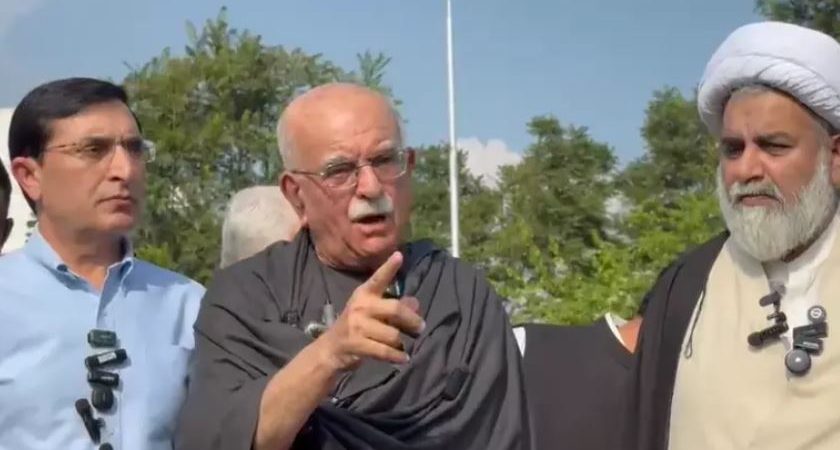
ISLAMABAD, OCT 12: National Assembly Opposition Leader Mehmood Khan Achakzai on Monday drew a comparison between Khyber Pakhtunkhwa and Balochistan, criticising the government’s move to impose emergency and governor’s rule in the former.
The federal government on Sunday imposed emergency in 12 districts of KP, and placed the province under governor’s rule, taking note of the “provincial government’s deliberate disengagement from the fight against terrorism”.
Prime Minister Shehbaz Sharif chaired the federal cabinet meeting that approved the measure, and said regarding terrorism in KP and Balochistan that “the way common citizens are being martyred, the way police officials and security officials, children and mothers [..] there can be nothing more heart-wrenching”.
Speaking to media outside the Parliament House on Monday, Achakzai claimed that there was no writ of the state in half of Balochistan.
“But you don’t impose it there, because the chief minister there is your favourite,” he alleged.
Achakzai’s claim of a lack of the state writ in half of Balochistan was apparently in connection with the security situation in the province.
Both KP and Balochistan have been facing terrorism, and according to the data compiled by the Pakistan Institute for Conflict and Security Studies (PICSS), 199 terrorist attacks were recorded in August across Pakistan, out of which KP, excluding the merged districts, recorded 54 terrorist attacks, while Balochistan recorded 89.
Speaking alongside Achakzai, Senate Opposition Leader Raja Abbas Nasir also drew the Balochistan parallel. “If terrorism and peace were an issue … you should have imposed emergency in Balochistan first,” he said.
Voicing his criticism of the government’s Oct 11 move, he said: “They call themselves the torchbearers of the law and the Constitution. However, they first attacked the Constitution by coming into power through Form-47 and now by signing the orders of imposing emergency against a government that held a two-thirds majority.”
‘Assault on democracy’
In his remarks assailing the Centre’s move, Achakzai said, “This will not be tolerated. It is the responsibility of everyone who values Pakistan and democracy to unite against this.”
He said parties in the opposition would be asked to announce a “democratic struggle” against the move from tomorrow in areas where they had influence.
“We will not abuse anyone; we will not fire bullets — we don’t have any — and we will not throw even a stone on anyone.”
He said the move was an “assault on Pakistan’s Constitution and democracy”.
“It is the duty of every Pakistani, whether he is a judge, general, in government or not in government, to resist this.”
Centre’s decision to impose emergency and governor’s rule in KP followed weeks of political tensions, with the PTI intending to march to Islamabad to demand the release of its jailed founder, Imran Khan. The march was led by suspended KP Chief Minister Sohail Afridi.
Achakzai said Afridi was just demanding access to and medical treatment for Imran.
He reiterated the demand for access to Imran and assured that the PTI leaders would not disclose the details of their conversation with Imran if meetings were allowed. They would only inform the public about his health condition, he said.
He added that the opposition was still willing to hold negotiations with the government, but would also “continue its struggle against this system”.
“They say that Mehmood doesn’t want to meet. Am I mad? Pakistan is not just the Prime Minister’s House or the speaker’s chamber; Pakistan is bigger than that,” added Achakzai, who has said that he would not hold any meetings with government representatives at the Prime Minister’s House or Office or at the chamber of the NA speaker.
He said he was ready to hold a meeting at anyone’s personal residence.
Achakzai then invited other political parties to attend a planned all-parties conference to discuss how the country should be run.
Gohar to approach PHC
PTI Chairperson Barrister Gohar Khan was also present on the occasion and announced that he would challenge the federal government’s decision to impose emergency and governor’s rule in KP in the Peshawar High Court (PHC) tomorrow (Tuesday).
Moreover, a parliamentary party meeting the same day would decide on how to stage a protest in Parliament, he added.
“We will raise our voice at every forum. Our long march and protest are ongoing,” Barrister Gohar said, adding that the party would not accept emergency and governor’s rule in KP.
“Whatever happened on October 11 should not have happened. October 11 will be remembered as a black day in Pakistan’s democratic history,” he said.
In a statement, the PTI particularly lambasted the PML-N and its ally PPP, saying the imposition of emergency and governor’s rule would add another “black mark” to their democratic credentials.
PTI Central Information Secretary Sheikh Waqas Akram, in the statement, accused both parties of supporting undemocratic and unconstitutional measures while invoking the slogans of democracy.
Terming Oct 11 a “black day for democracy”, Akram asserted that neither PTI nor the people of KP would accept the “unconstitutional, undemocratic and unlawful imposition of governor rule and emergency in the province, or the removal of its elected government”.
He announced that the party would continue its peaceful democratic struggle through the courts, parliament, provincial assemblies and public mobilisation until justice was achieved.
Akram said that the PPP and PML-N should be judged against their political records rather than their repeated claims of championing democracy.
He recalled that PPP founder and former prime minister, Zulfikar Ali Bhutto, dismissed the Balochistan government led by Sardar Attaullah Mengal in 1973, followed by governor’s rule and a prolonged confrontation with provincial leadership.
Akram also referred to governor’s rule in the then North-West Frontier Province during ex-PM Benazir Bhutto’s government in 1994, its imposition in Punjab under then-President Asif Ali Zardari in 2009, and the removal of the Balochistan government led by Nawab Aslam Raisani in 2013.
Criticising the PML-N, Akram cited the 1997 attack on the Supreme Court by party supporters, the nationwide emergency imposed during ex-PM Nawaz Sharif’s government in 1998, the “theft” of PTI’s electoral mandate in the February 2024 general elections, the subsequent usurpation of its reserved seats, and the passage of Constitutional amendments, adding that these actions further undermined democratic principles and the public’s electoral mandate.
The PTI information secretary urged political leaders to learn from the events of 1971, recalling that the Awami League had won a majority in the 1970 general elections but was unable to assume power through a democratic transfer.
He said that the failure to respect the electoral outcome and the political confrontation contributed to a national tragedy whose consequences remain deeply significant.
“Pakistan cannot afford to repeat the mistakes of denying political representation or marginalising smaller provinces, as national unity depends on constitutional rule, respect for the people’s vote and meaningful provincial autonomy,” Akram stressed.
He questioned the federal government’s justification for suspending the KP government, adding that terrorism required coordinated national action rather than political confrontation.
Referring to figures attributed to the Centre for Research and Security Studies (CRSS), he said fatalities involving security personnel and civilians in KP had declined by 16 per cent during the first nine months of 2026, while nationwide fatalities had increased by 9 per cent, partly amid worsening violence in Balochistan.
He called for a transparent assessment of these figures and the effectiveness of security policies.
Outlining the party’s next steps, he said that PTI would “challenge the decision before the courts, pursue all available constitutional remedies and raise the matter in parliament, provincial assemblies and other relevant forums”.
He said the party would continue peaceful public mobilisation until the elected government’s authority and the constitutional rights of the people of KP were restored.
The information secretary demanded the “immediate reversal of the emergency and governor’s rule, the restoration of the elected provincial government and meaningful dialogue to resolve the country’s political crisis”.
Related News

National Grid Pakistan signs MoU with TEVTA Punjab to strengthen power sector skills development
ISLAMABAD, Oct 12 (DNA):National Grid Pakistan has signed a Memorandum of Understanding (MoU) withRead More

Ishaq Dar chairs committee on conservation and austerity measures
ISLAMABAD, OCT 12 /DNA/ – Deputy Prime Minister/Foreign Minister Senator Mohammad Ishaq Dar @MIshaqDar50 chairedRead More
Comments are Closed