

Taliban regime has itself become a proxy trying to destabilize the region
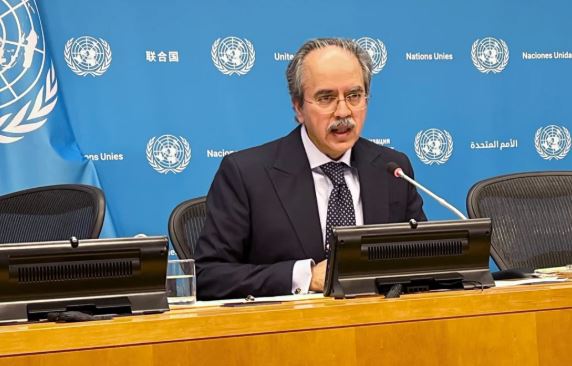
Asim Iftikhar Ahmad traced the international community’s current frustration to expectations set out during the 2020 Doha talks between the US and the Taliban, and reaffirmed as the group took power the following year.
Ambassador Asim Iftikhar Ahmad, Alternate Permanent Representative of Pakistan to the UN delivering the statement during the UNGA session on the adoption of a Resolution titled “Advancing a comprehensive, just and lasting
Monitoring Desk
NEW YORK CITY: Five years after the Taliban swept into Kabul, Pakistan’s ambassador to the UN, Asim Iftikhar Ahmad, is not walking back Defense Minister Khawaja Asif’s February declaration that the two countries are in “open war.”
“The trends are posing grave concern,” Ahmad told Arab News in an interview marking the fifth anniversary of the takeover, pointing to reports from the UN’s own sanctions monitoring team and the secretary-general on Afghanistan’s renewed role as “a safe haven for a number of terrorist groups.”
Ahmad described a steady deterioration in Kabul’s conduct since the Taliban returned to power on Aug. 15, 2021.
“Pakistan’s basic position and basic approach towards Afghanistan and the people of Afghanistan remains the same,” he said, describing the two countries as “next door neighbors” bound by “deep rooted and longstanding” ties.
He stressed that Islamabad’s quarrel is not with ordinary Afghans, who he said have borne the brunt of “decades of instability and conflict.” Pakistan, he added, has “felt and has been impacted directly by the consequences of that period of instability” more than any other country.
Ahmad traced the international community’s current frustration to expectations set out during the 2020 Doha talks between the US and the Taliban, and reaffirmed as the group took power the following year.
There were three core benchmarks: an inclusive government, respect for human rights — particularly the rights of women and girls — and a guarantee that Afghan soil would not be used to stage terrorism against any other country.
Pakistan did not simply wait to see whether Kabul would deliver, Ahmad said. Within four months of the takeover, Islamabad convened an extraordinary session of the Organization of Islamic Cooperation’s foreign ministers in December 2021 to rally international support for Afghanistan’s recovery.
Five years on, he said, the record is one of regression rather than progress on all three fronts, with continued restrictions on girls’ education and women’s employment as evidence on the human rights front, and an exclusionary governance structure that has failed to broaden.
Ahmad said the frequency and intensity of attacks linked by Pakistan to militant groups operating from Afghanistan had surged. He cited more than 5,200 terrorism-related incidents in Pakistan in 2025 and more than 1,300 deaths — figures that include categories broader than independently verified attacks traced to Afghan soil.
Behind those numbers, Ahmad named three groups he holds primarily responsible: Tehreek-e-Taliban Pakistan, the Balochistan Liberation Army and the Majeed Brigade, alongside Daesh’s regional affiliate. He described the first three as increasingly acting “as proxies to our adversaries in the region.”
Asked directly whether the Taliban are deliberately sheltering the TTP or simply unable to rein it in, Ahmad said the evidence, from UN monitoring team reports and Pakistan’s own intelligence, points to the more serious explanation.
“In fact, the way the whole thing is operating now, it’s basically the Taliban regime itself is a proxy, trying to destabilize the entire region,” Ahmad said, arguing this serves neither Pakistan’s interests nor those of ordinary Afghans.
The Taliban has denied fostering ties with the TTP or other militant groups.
Pressed on what should happen next — whether the burden falls on Pakistan’s military, or on outside powers with leverage over Kabul — Ahmad said responsibility lies squarely with the Afghan side, even as he acknowledged Pakistan’s own forces have paid “a heavy toll” patrolling the porous, roughly 2,600-kilometer Durand Line and striking militant targets.
He raised the possibility of a formal religious edict, or fatwa, from senior Taliban clergy against groups like the TTP, paired with “concrete, verifiable steps” to deny them safe haven and financing.
Ahmad listed Saudi Arabia, Turkiye, China and Qatar as “common friends” of both Islamabad and Kabul who have attempted to mediate — all of whom were involved in brokering the ceasefire and subsequent Istanbul talks earlier this year — but said the Taliban side has consistently declined to give the assurances sought.
Asked who, if anyone, the Taliban leadership actually listens to, Ahmad was blunt: “It’s a strange situation. I think it’s up to them to decide,” adding that “some serious introspection is in order” given Afghanistan’s isolation, frozen assets and lack of formal recognition — outcomes he said the group could reverse if it wanted development and investment instead.
Ahmad argued that the “time and space” given by the international community to the Taliban after 2021 — including through the UN’s own engagement framework — has yielded no reciprocal steps from Kabul on any of the three benchmarks.
He drew a comparison with Washington’s approach to the Taliban’s detention of American nationals, noting that the US has denied the group’s leadership travel-ban exemptions over what it calls “hostage diplomacy.”
If that standard applies to individual hostages, Ahmad argued, it should apply with even greater force to a “continuous stream of attacks” against Pakistani citizens that he says Kabul actively enables.
On whether fellow Muslim-majority states retain unique leverage over the Taliban, Ahmad recalled Pakistan working alongside Indonesia and Saudi Arabia after 2021 to make the case — including on girls’ education — that the Taliban’s restrictions on women “are not actually in line with Islamic teachings or traditions.”
Western governments, he added, have no objection in principle to an Islamic system of government in Kabul, only to policies that discriminate against women or minorities — an obstacle he said is entirely within the Taliban’s power to remove.
Related News
Islamabad’s rightful demand from Kabul is not to allow its soil to be used against Pakistan
DNA ISLAMABAD, Aug 31: Experts at a roundtable discussion at the Institute of Regional StudiesRead More
Taliban regime has itself become a proxy trying to destabilize the region
Asim Iftikhar Ahmad traced the international community’s current frustration to expectations set out during theRead More
Comments are Closed