

D-8 chief urges private sector to boost intra-bloc trade
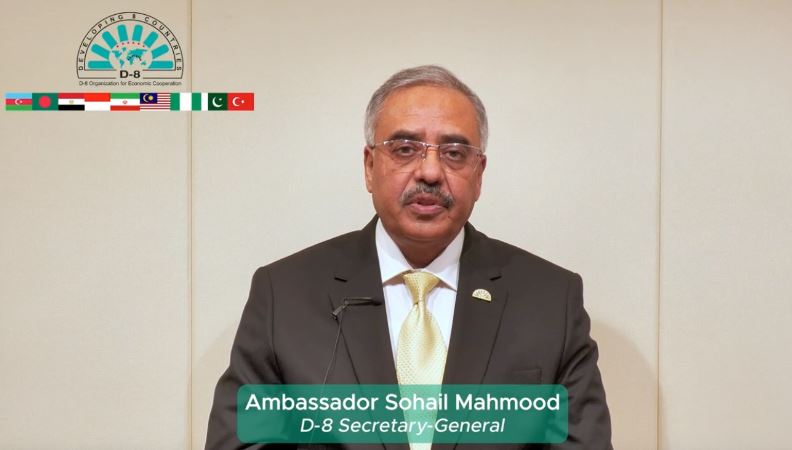
D-8 Secretary-General stresses private sector’s central role in enhancing intra-d-8 trade and accelerating economic integration
ISTANBUL, JUL 28 /DNA/ – The Secretary-General of the Developing-8 Organization for Economic Cooperation (D-8), Ambassador Sohail Mahmood, has called for stronger collaboration between governments and chambers of commerce, and stressed the central role of the private sector in realizing the Organization’s ambitious target of US$500 billion in intra-D-8 trade by 2030 and accelerating economic integration.
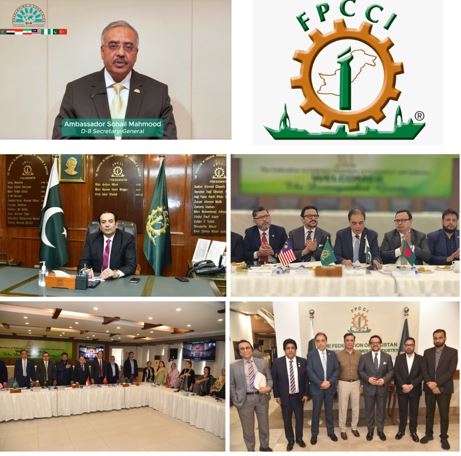
The Interactive Session on “Economic Integration among the Developing Eight: Current Status and Future Prospects,” organized by the Federation of Pakistan Chambers of Commerce and Industry (FPCCI), brought together representatives of national chambers of commerce, senior government officials, diplomats from D-8 Member States, business leaders, exporters, industrialists, and private-sector stakeholders. The Director-General from the Pakistan Ministry of Foreign Affairs, Mr. Irfan Soomro, also participated and shared detailed perspective on the subject.
Held in a hybrid format with both physical and virtual participation, the event served as an important platform to deliberate on practical measures for expanding intra-D-8 trade, enhancing investment cooperation, improving banking and financial connectivity, promoting business-to-business (B2B) engagement, and accelerating effective implementation of the D-8 Preferential Trade Agreement (PTA).
In his address on the occasion, delivered through a special video message, Secretary-General Ambassador Sohail Mahmood emphasized that the D-8’s economic potential can best be realized through stronger implementation of the D-8 PTA, deeper regional value chains, enhanced investment flows, and intensified private-sector engagement. He noted that the D-8 represents nearly 1.3 billion people, a combined GDP exceeding US$5 trillion, and intra-bloc trade of approximately US$160 billion. He stressed that the private sector had the most vital role to play in helping realize the Organization’s target of increasing intra-D-8 trade to US$500 billion by 2030 set in the D-8 Decennial Roadmap 2020-2030.
The Secretary-General welcomed recent progress in strengthening the D-8 trade architecture, including Egypt’s ratification and Pakistan’s operationalization of the D-8 PTA. He underscored that the chambers of commerce and the private sector remain indispensable in translating policy frameworks into tangible commercial outcomes through stronger business partnerships, raising awareness about possibilities under the PTA, and expanding opportunities for trade and investment. He also highlighted the Trade Ministers’ decision regarding establishment of the Permanent Secretariat of the D-8 Chamber of Commerce and Industry (D-8 CCI) in Istanbul, in collaboration with the Union of Chambers and Commodity Exchanges of Türkiye (TOBB), as a major institutional milestone for advancing regional economic cooperation.
In his opening remarks, FPCCI President Mr. Atif Ikram Sheikh emphasized that the D-8 possesses enormous untapped economic potential that can only be realized through stronger institutional cooperation and greater private-sector participation. Calling for a more action-oriented D-8 economic agenda, he urged the immediate and effective implementation of the D-8 PTA and presented a number of practical proposals to strengthen regional business connectivity. These included organizing a D-8 CCI Expo under the auspices of FPCCI, convening at least two virtual meetings of the D-8 CCI each year, establishing a dedicated digital platform and website for the D-8 CCI to facilitate business networking and information-sharing, and further simplifying visa procedures for businesspersons to facilitate trade, investment, and commercial exchanges among D-8 Member States.
Chairing the session, FPCCI Senior Vice President Mr. Saquib Fayyaz Magoon reaffirmed the private sector’s readiness to play a leading role in advancing regional economic integration. Participants broadly supported stronger business-to-business engagement, enhanced banking and financial connectivity, regular trade fairs and investment forums, and closer cooperation among national chambers of commerce to unlock new opportunities for trade, investment, innovation, and joint ventures, particularly for small- and medium-sized enterprises (SMEs).
Reaffirming the Secretariat’s commitment to advancing the D-8 economic agenda, Secretary-General Ambassador Sohail Mahmood stated that the D-8 Secretariat would continue working closely with Member States, chambers of commerce, business associations, and all other relevant stakeholders. He underlined that achieving the set targets in trade and economic integration would require stronger political commitment, effective implementation of trade instruments, and, above all, active engagement of the private sector across the D-8 geography. It would also require enhanced customs cooperation, improved hard and soft connectivity, digital integration, and predictable cross-border and transit systems, he stressed.
The D-8 Secretariat welcomed FPCCI’s initiative in convening this timely dialogue and its concrete recommendations for advancing economic integration among D-8 Member States. The Secretariat expressed confidence that the proposals emerging from the session would provide valuable impetus for strengthening the implementation of the D-8 economic cooperation agenda and contribute meaningfully to the realization of the D-8 Decennial Roadmap (2020–2030), reinforcing the Organization’s role as a leading platform for South-South economic cooperation.
Related News

(Untitled)
ISLAMABAD: State Minister for Interior Talal Chaudhry on Tuesday said the federal government would fullyRead More
PM reviews progress on ‘Apna Ghar Scheme,’ directs faster implementation
ISLAMABAD, July 28: Prime Minister Muhammad Shehbaz Sharif, Tuesday, reaffirmed that providing affordable housing toRead More
Comments are Closed